The SAVE Plan Is Gone: What Student Loan Borrowers Need to Do Before July 1

Junior Y.
Founder, Spendify

The U.S. Department of Education has officially wound down the Saving on a Valuable Education (SAVE) plan after a federal court ruled it unlawful. Federal Student Aid started emailing affected borrowers in early May to inform them that SAVE has ended and to help them select a new repayment plan. Roughly 8 million borrowers are affected.
Starting July 1, 2026, you have 90 days to pick a new plan. If you don’t, the Department picks one for you, and it’s the Standard 10-year plan, which has the highest monthly payment of any option. If you were on SAVE because you couldn’t afford the Standard payment, the auto-default is the wrong answer for you. This post walks through the realistic choices.
Disclosure: We make Spendify, a personal finance app that includes debt-payoff planning. We don’t service student loans. Everything here is general guidance based on what the Department of Education, FSA, and major nonprofit advisors (TISLA, NerdWallet, TICAS) have published as of mid-May 2026.
What changed and what’s still true
What changed:
- SAVE plan is over. The legal injunction stopped new enrollments months ago; the formal wind-down starts July 1, 2026.
- IBR, PAYE, and ICR are phased out for new loans originated after July 1, 2026. Existing loans can still use them.
- Replacement repayment plans (named in 2025 reconciliation legislation) are coming, but not all are live yet. The full menu of new plans will be the standard going forward.
- Months spent in SAVE forbearance (after the legal injunction) do not count toward PSLF or any IDR forgiveness clock.
What’s still true:
- Public Service Loan Forgiveness (PSLF) is still in place for direct-loan borrowers working at government or nonprofit employers.
- Active months of SAVE repayment (before the injunction) count toward PSLF.
- The Department is required to offer at least one income-driven option for federal direct loans.
- Refinancing to a private lender permanently gives up all federal protections, and that’s still rarely the right move.
The choice matrix
For an existing federal direct-loan borrower formerly on SAVE, the practical options after July 1, 2026:
| Plan | Payment | Forgiveness clock | Available to existing borrowers? |
|---|---|---|---|
| Income-Based Repayment (IBR) | 10% or 15% of discretionary income, capped at Standard 10-yr | 20 yrs (post-2014 IBR) or 25 yrs (pre-2014) | Yes, but phased out for new loans after 7/1/26 |
| Pay As You Earn (PAYE) | 10% of discretionary income, capped at Standard 10-yr | 20 years | Yes, but phased out for new loans |
| Income-Contingent Repayment (ICR) | 20% of discretionary or 12-yr fixed-equivalent, whichever is less | 25 years | Yes (the only IDR for Parent PLUS borrowers via consolidation) |
| Standard 10-year | Fixed monthly to pay off in exactly 10 years | N/A, paid off in full | Yes; this is the auto-default |
| Graduated | Lower payment first, increases every 2 years | N/A | Yes |
| Extended | Up to 25 years, fixed or graduated | N/A | Only if you have >$30K in direct loans |
Replacement IDR plans from the 2025 reconciliation package are being rolled out by FSA through 2026-2027; check StudentAid.gov for the current menu when you make your decision.
How to pick (in plain English)
If you were on SAVE because you genuinely couldn’t afford Standard payments
Pick IBR or PAYE. They have the lowest monthly payment among the currently-available plans. PAYE caps payments lower than IBR for most people but has tighter eligibility (you must have been a “new borrower” as of October 2007 with at least one direct loan disbursed after October 2011). If PAYE eligibility is unclear, IBR is the safer choice.
If you’re pursuing PSLF
Stay on an IDR plan (IBR, PAYE, or ICR). PSLF requires it. Pick whichever has the lowest payment you qualify for. Track the qualifying-payment count manually because the wind-down has created counting errors on multiple servicers. Cross-reference your count with the PSLF Help Tool quarterly.
If your income has grown a lot and you can afford a real payoff
Standard or Graduated is fine if your debt-to-income is reasonable. You’ll pay less total interest because Standard amortizes over a fixed schedule. If you have a lot of debt relative to income, IDR is still the move. Standard will eat your budget.
If you’re inside 3 years of being debt-free anyway
Skip the IDR math entirely. Aggressively pay it down. Drop to whatever IDR plan has the lowest required minimum, then throw every extra dollar at the loan. Treat it like high-APR debt even though the APR isn’t actually that high. Being done with student loans has real value the spreadsheet doesn’t capture.
The decision deadline, in concrete dates
- Now-June 30, 2026: Read your FSA email if you have one. Log into StudentAid.gov and confirm which plan you’re currently in (or in forbearance), your loan balance, your servicer, and any PSLF qualifying-payment count.
- July 1, 2026: 90-day decision window opens. You can pick your new plan starting today.
- Late September 2026 (estimated): End of the 90-day window. If you haven’t chosen, the Department selects Standard 10-year.
- After the deadline: Late switches are possible (you can change plans annually under IDR rules) but the auto-assigned plan starts billing immediately, which can mean a payment 3-5x what you were paying on SAVE.
If you only do one thing this month: log into StudentAid.gov, verify which loans you have and your current status, and bookmark the date.
What this means for the rest of your debt picture
Student loans are often the second- or third-largest debt for a typical 2026 borrower. Credit cards usually come first (see why 111M Americans can’t pay their cards →). The right priority depends on APRs:
- Federal student loan APR: typically 4-7%
- Credit card APR: typically 22-29%
- Mortgage APR (existing, fixed): 3-7% depending on when you got it
If you’re carrying credit-card debt at 22%+ APR, that’s the first dollar, even before extra payments on student loans. Pay the IDR minimum on student loans, attack the cards. Once cards are gone, reassess whether to accelerate student loans or invest (the decision tree → walks through this).
Where Spendify fits
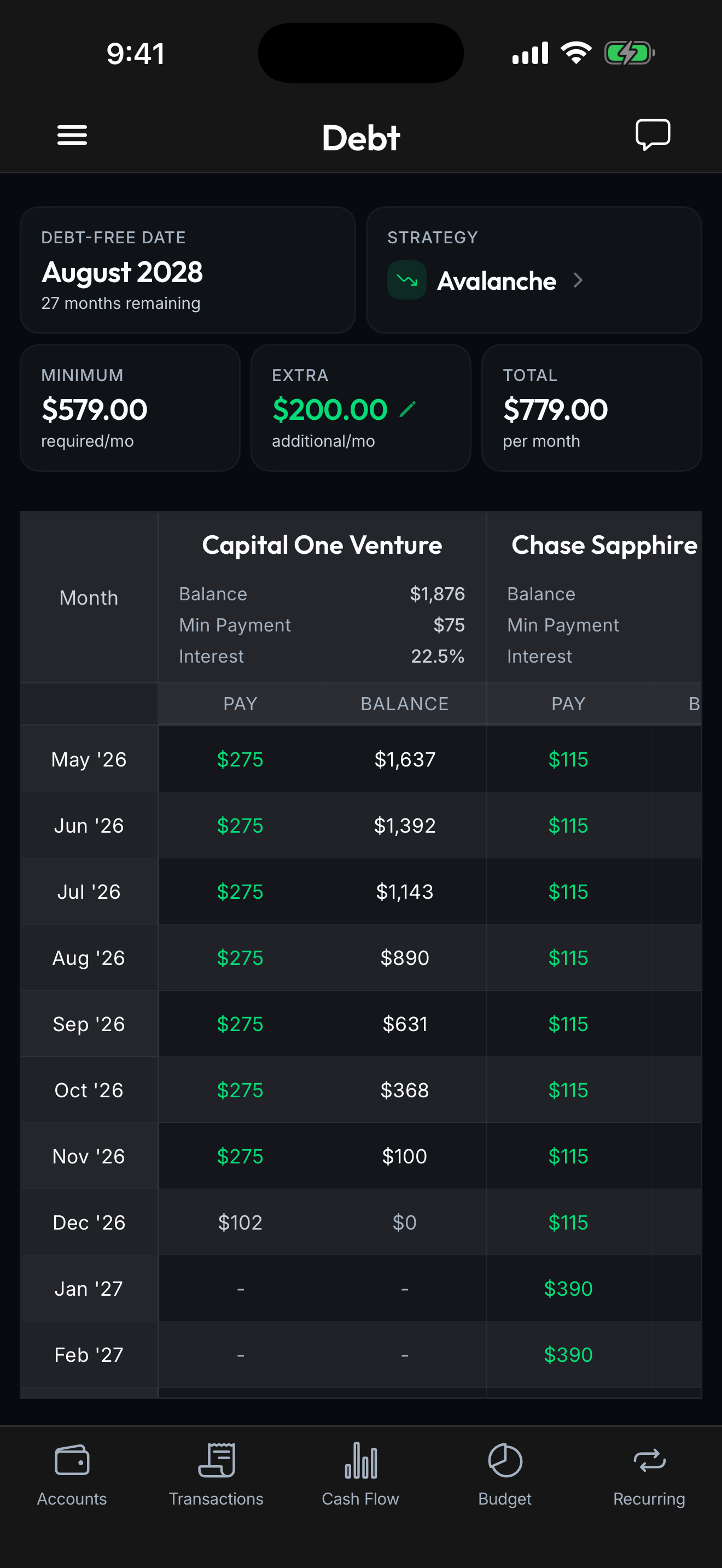
The reason “what’s my total monthly debt picture” feels confusing right now is that the rules for one of the biggest pieces (federal student loans) just changed, and the new minimum on whatever plan you pick will be different from what you were paying. Spendify pulls in all your balances (cards, student loans, mortgages) via Plaid read-only, lets you set your new SAVE-replacement minimum once you’ve chosen, and recalculates your overall debt-free date in real time. Snowball vs avalanche vs custom strategy, side-by-side, with the SAVE shift accounted for.
$4.99/month or $49.99/year with a 7-day free trial. iOS + Android.
See the debt payoff features → · Free debt payoff calculator →
Related reading: Why 111M Americans can’t pay their credit cards · Fed rate hike: what it means · Student loan payoff calculator guide · How to create a debt payoff plan