Should You Invest While You're in Debt? The 2026 Decision Tree

Junior Y.
Founder, Spendify

If you have credit card debt and a 401(k) and student loans and you’ve ever wondered “should I invest while I pay this off, or all-in on the debt first?” You’re in good company. The honest answer is that there’s a clear math rule for most cases, a gray zone where personality matters, and one trap that wastes more money than the math itself.
This is the decision tree, in real dollars, calibrated for the 2026 rate environment.
Disclosure: We make Spendify, which is built around the debt-payoff side of this question. We’re going to be honest about where the answer is “invest first.” That’s most of the gray-zone case.
The core principle
Every dollar you have can do one of three things:
- Pay down debt: guaranteed return equal to the debt’s APR
- Sit in cash: guaranteed return equal to the HYSA APY (4-5% in May 2026)
- Invest: expected return of ~7% real long-term (S&P 500-ish), but with real downside risk in any given year
“Guaranteed” is doing heavy work in option 1. Paying off a 24% APR credit card is mathematically identical to earning a 24% return, and unlike investing, you can’t lose it. That’s why the standard advice exists: high-APR debt usually wins.
The interesting question is everything in the 4-9% range, where the math gets closer and personality starts to matter.
The decision tree
Step 1: Do you have $1,000-2,000 in a starter emergency fund?
  └─ NO → Build that first. Without it, surprise expenses go back on the card.
  └─ YES → Step 2

Step 2: Does your employer offer a 401(k) match you're not maxing?
  └─ NO → Step 3
  └─ YES → Contribute enough to capture the full match BEFORE anything else.
           Even with 24% credit card debt. The match is a 50-100% return.
           After capturing match → Step 3

Step 3: What's your highest-APR debt?
  ├─ 8%+ APR (most credit cards, some personal loans, private student loans):
  │   → Pay it down aggressively before investing beyond the match.
  ├─ 5-7% APR (some student loans, current mortgages, low-APR personal loans):
  │   → Gray zone. Read the next section.
  └─ <5% APR (low-rate mortgage, federal subsidized student loans, 0% promos):
      → Pay minimums and invest the difference.

Step 4: Do you have a 3-6 month full emergency fund yet?
  └─ NO → Build it in parallel with investing. Don't skip it.
  └─ YES → Increase investment contributions until you hit your retirement target.
That’s the whole thing. The interesting part is step 3.
The gray zone (5-7% APR debt)
If your highest-APR debt is in the 5-7% range, like federal student loans at 6.5%, a 6% mortgage, or a 5.5% personal loan, the math is close enough that there’s no obviously right answer. A diversified stock portfolio has historically returned ~7% real long-term, but the operative word is long-term. In any given year, it can be down 30% or up 30%. Your loan APR is fixed.
The honest framework:
Lean toward paying debt down if:
- You’d panic-sell investments in a downturn (most people overestimate their tolerance here)
- The debt is “loud”: you think about it often, it stresses you out
- You’re within a few years of being debt-free if you focus
- The interest isn’t tax-deductible
Lean toward investing if:
- The debt is tax-advantaged (mortgage interest deduction, student loan interest deduction)
- You have a long time horizon (15+ years) where compounding favors the equity return
- You have decades of investing temperament showing you don’t panic-sell
- You have tax-advantaged investment space available (IRA, HSA contribution room)
For most people in the gray zone, the behavioral answer is “do both”: 70% of the extra cash to debt, 30% to investments, until the debt is gone. Slower than all-in either way, but more sustainable, and you don’t get to your debt-free date and realize you’ve been out of the market for five years.
The 2026 wrinkle: a hawkish Fed changes the math slightly
In May 2026, the Fed is signaling a higher chance of rate hikes than cuts (CNBC, May 12-13). Two implications:
- Variable-rate debt gets riskier. Cards, HELOC, and ARM mortgages all reset upward if the Fed hikes. A 22% card APR becomes 23-24% APR. That tightens the case for aggressive payoff before investing.
- HYSA returns stay strong, expected stock returns don’t change much. The 4-5% HYSA floor is real money for an emergency fund. Equity returns aren’t materially different in a high-rate environment. They’re still ~7% real long-term.
The net adjustment: in a hawkish Fed cycle, weight slightly more toward paying off variable-rate debt and slightly less toward “invest in everything I have left.” Fixed-rate debt at 5-6% is still in the gray zone.
Deeper take on what a Fed hike means →
Three traps that waste more money than the math itself
Trap 1: Skipping the employer match because of high-APR debt
The single most expensive mistake. A 50% employer match means $1 contributed becomes $1.50 immediately. A 100% match means $1 becomes $2. No credit card APR beats those returns. If you’re skipping the match to throw more at debt, you are leaving free money on the table.
Trap 2: All-cash because “the market feels risky”
A 4-5% HYSA APY feels safe, and in nominal terms it is. In real terms, with inflation running 3.5-4%, you’re earning ~1% real return on cash. Long-term wealth doesn’t get built on 1% real returns. Cash is for the emergency fund and short-term goals, not for retirement.
Trap 3: Investing in a brokerage account before maxing tax-advantaged accounts
Order matters. 401(k) up to the match → high-APR debt → IRA → HSA → 401(k) up to the contribution limit → THEN taxable brokerage. Skipping tax-advantaged space to invest in a regular brokerage means you’re paying capital gains tax that you didn’t have to.
What “doing both” actually looks like
A realistic split for someone with a $5,000 credit card balance at 24%, $20,000 in federal student loans at 6.5%, an employer 401(k) match up to 4% of salary, and $400/month to allocate:
| Step | Monthly action |
|---|---|
| 1 | Contribute 4% of salary to 401(k) to capture full match. (Comes out of paycheck, not the $400.) |
| 2 | $0/month to brokerage investing for now. |
| 3 | $350/month to the credit card (above minimum). |
| 4 | $50/month above minimum to the student loan (token progress, mostly minimums). |
| When CC is paid off | Roll the $350 to the student loan. |
| When SL is in the gray zone | Reassess, split between SL and IRA contributions. |
This is opinionated. It’s not the only right answer. But it’s the answer that matches the math and the behavioral evidence for most people.
Where Spendify fits
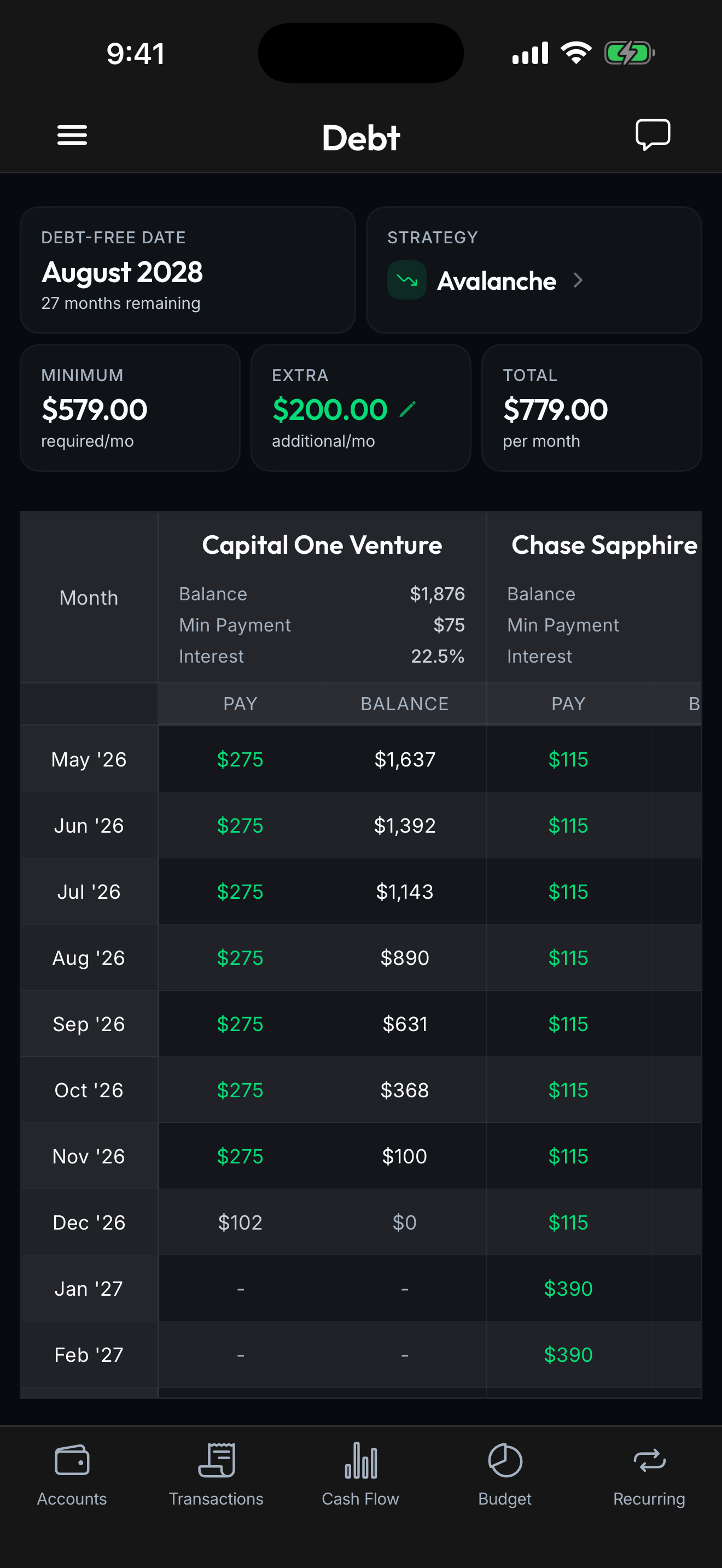
The hardest part of the “invest or pay debt” question is seeing the picture. Most people don’t actually know their highest APR, their debt-free date under the current plan, or how a $200 monthly shift would change the timeline. Spendify shows your real debt-free date based on actual balances and APRs, lets you run what-if scenarios (extra $X/month, balance transfer, switch strategies) and updates the timeline in real time. The decision between “invest” and “pay off” gets easier when you can see what each path actually costs in time and dollars.
$4.99/month or $49.99/year with a 7-day free trial. iOS + Android.
See the debt payoff features → · Free debt payoff calculator →
Related: When to start investing · AI financial advisor vs human · Debt snowball vs avalanche · Why your debt-free date matters