What 'Debt-Free' Actually Means (And Why the Date Matters More Than the Number)

Junior Y.
Founder, Spendify

The number that matters isn’t your balance
If someone asked you about your debt right now, you’d probably say a number. “$18,000.” “$42,000.” “$7,500 on a credit card and $23,000 in student loans.”
That number is important. But it’s also paralyzing. $18,000 is an abstract weight that sits on your chest. It doesn’t tell you what to do next, how long this will take, or whether your current payments are actually getting you anywhere.
Your debt-free date does all of those things.
A number vs. a destination
“I have $18,000 in debt” is a statement about where you are.
“I’ll be debt-free by November 2027” is a statement about where you’re going.
That difference matters more than it sounds. Research in behavioral psychology consistently shows that people are more motivated by concrete goals with deadlines than by abstract targets. A runner training for a marathon on April 15th trains differently than someone who just “wants to run more.”
Debt works the same way. When you can see a specific month and year, and watch it move closer as you make payments, the debt stops being an amorphous cloud of stress and becomes a countdown.
The three things a date tells you that a balance doesn’t
1. Whether your current plan is working
If you’re making $500/month in debt payments, is that enough? Your balance alone doesn’t answer this. It goes down a little, interest gets added, you make another payment, and it goes down a little more. Hard to tell if you’re making real progress or treading water.
A debt-free date makes it obvious. If your date is 6 years out and you want it to be 3, you know your current payments aren’t enough. If it’s 18 months out, you know you’re on track. No ambiguity.
2. How much your strategy matters
The difference between paying minimums and adding an extra $200/month might be the difference between “debt-free in 2032” and “debt-free in 2028.” The difference between snowball and avalanche might save you $530 and 4 months.
You can’t see these differences by looking at your balance. You can see them instantly when you compare debt-free dates.
3. What trade-offs are actually worth it
“Should I skip that vacation to put the money toward debt?” Hard question when you’re looking at a $18,000 balance. That $2,000 vacation is only 11% of your total debt. Feels like a drop in the bucket.
But if that $2,000 moves your debt-free date from March 2028 to November 2027? Four months of freedom earlier. Now you can make an informed decision instead of a guilt-driven one.
Why most apps don’t show this
Most finance apps show your balance, your transactions, and maybe a chart of your balance over time. Very few calculate a debt-free date, because doing it right requires knowing:
- Every debt account (balances, interest rates, minimum payments)
- Your actual payment amounts (not just minimums)
- Which debts you’re prioritizing
- How interest compounds across accounts
It’s not a simple calculation. It’s a multi-variable projection that changes every time you make a payment, get charged interest, or adjust your strategy.
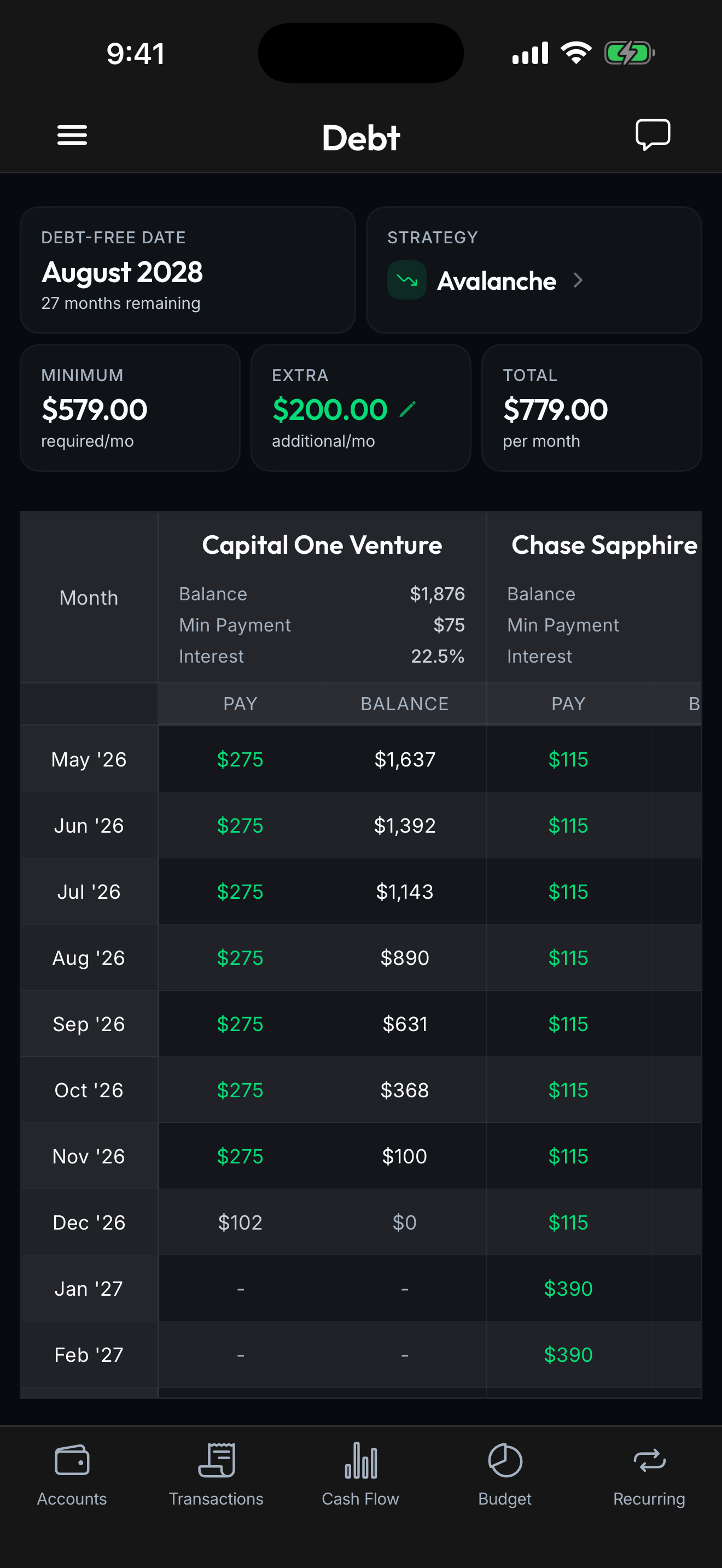
This is exactly why we built Spendify around the debt-free date as the core feature. When you connect your accounts, Spendify doesn’t just show you balances. It calculates your exact debt-free date for three different strategies, snowball, avalanche, and custom, and updates it in real time.
The psychology of a countdown
Something shifts when you can see the end. Researchers call it the “goal gradient effect”: the closer you get to a goal, the harder you work toward it. It’s why loyalty punch cards work (people buy more coffee when they’re one stamp away from a free one) and why marathon runners speed up in the final mile.
A debt-free date gives you that gradient. Every payment moves the date forward. Every extra dollar you throw at debt makes it move faster. You can see the finish line approaching, and that visibility creates momentum.
Compare that to staring at a balance that goes down slowly, with no clear endpoint. Same financial situation, completely different psychological experience.
What-if: the feature that makes the date useful
A static date is helpful. A date you can experiment with is powerful.
“What if I add $100/month to my payments?” Watch the date move.
“What if I get a tax refund and put $2,000 toward my highest-rate card?” Watch it move again.
“What if I switch from snowball to avalanche?” See the exact difference in months and dollars.
This is what Spendify’s what-if scenarios do. You adjust one variable and instantly see how it changes your debt-free date, total interest paid, and monthly payment amount. It turns abstract financial decisions into concrete, visual outcomes.
How to find your debt-free date
If you’re currently managing debt, here’s the minimum you need:
- List every debt. Balance, interest rate (APR), and minimum payment for each.
- Decide your total monthly payment. Minimums across all debts, plus whatever extra you can afford.
- Pick a strategy. Snowball (smallest balance first), avalanche (highest rate first), or custom.
- Calculate. This is the hard part to do manually, which is why apps exist.
Spendify does steps 1-4 automatically when you connect your accounts. You see your debt-free date within minutes of signing up, with all three strategies compared side by side. No spreadsheet required.
Start with the date, not the balance
Next time you think about your debt, try reframing it. Instead of “I have $18,000 in debt,” try “I’ll be debt-free by [date].”
If you don’t know your date yet, that’s the first thing to figure out. It changes how you think about every financial decision: from whether to make an extra payment to whether to change strategies to whether that purchase is worth pushing your date back.
The balance tells you where you are. The date tells you where you’re going. Focus on the date.
If you want to see the math on your own numbers, our free debt payoff calculator will show you a date without asking for an account. And if you’re still deciding which strategy to use first, our guide on debt snowball vs. avalanche walks through the trade-offs with example numbers.
Frequently asked questions
Why does knowing my debt-free date matter?
A balance tells you where you are; a date tells you where you’re going. When your debt has a specific end month and year, it stops being an abstract weight and becomes a countdown you can watch move. That shift is what makes extra payments feel worthwhile. You can see the date jump closer in real time, which is a much stronger motivator than watching a balance creep down by small amounts while interest chips away at your progress.
How is a debt-free date calculated?
It’s a projection based on four inputs: each debt’s current balance, its interest rate (APR), its minimum payment, and how much extra you can put toward debt each month. The calculation runs amortization month by month across every account, applying your payoff strategy (snowball or avalanche) to decide which debt gets the extra money. Because interest compounds and payments shift as debts are eliminated, the math is tedious by hand. A calculator or app does it in seconds.
Can a debt-free date change?
Yes, and that’s the point. Your date moves every time your situation does. Missing a payment or adding new debt pushes it out. Making extra payments, getting a lower interest rate, or consolidating pulls it in. A useful debt-free date is a living number that updates with your real balances, not a one-time estimate you did on a napkin a year ago and forgot about.
Does paying extra change my debt-free date?
Significantly. On a $15,000 credit card at 24%, an extra $100 a month can cut roughly a year off your timeline and save thousands in interest. A $2,000 tax refund applied to a high-rate card can move your date up by four to six months. The exact impact depends on which debt the extra money goes toward, which is why strategy matters as much as the amount.
What tool can I use to calculate my own debt-free date?
You can use a spreadsheet if you’re patient with amortization formulas, a free web calculator like Undebt.it, or a connected app. Spendify’s free debt payoff calculator lets you enter your debts and see your date without signing up. If you want it to stay accurate automatically as balances change, a full app that syncs to your accounts saves the manual update work.