Best Mint Alternatives 2026: 8 Apps Ranked (Free & Paid)

Junior Y.
Founder, Spendify

Mint is gone, and the replacement recommendations are a mess.
Quick answer: The best Mint replacement in 2026 depends on what you need it for. For getting out of debt, it’s Spendify. For couples and families, Monarch Money. For zero-based budgeting, YNAB. For killing forgotten subscriptions, Rocket Money. For a free option, Empower (net worth) or Rocket Money’s free tier (subscriptions). The rest of this guide explains each pick, and who should skip it, by use case.
Every article pitches the same six apps, like Monarch, YNAB, Copilot, Rocket Money, EveryDollar, and Empower, ranked by generic criteria like “best overall” or “best free.” That’s not useful. Those apps serve different people. The best Mint alternative for a couple merging finances is not the same as the best alternative for someone with $30,000 in credit card debt.
This guide fixes that. Instead of ranking by vague “best of” categories, we organize Mint alternatives by what you’re actually going to use the app to do. Pick the use case that matches your situation and see the best app for it.
Disclosure: We make Spendify, so we’re biased. We’ll also be honest about where other apps are better, and we’ll tell you when an alternative is a stronger fit than we are for a given use case.
How we picked these apps
We included only apps that have genuine traction post-Mint shutdown and that solve a clear use case well. Every app here:
- Has been publicly available for at least 12 months (no pre-launch or beta-only tools)
- Supports bank sync through Plaid or equivalent for at least 10,000+ institutions
- Has a coherent product focus (not trying to do everything badly)
- Has pricing that’s transparent on its website
We excluded apps that are effectively dead (their homepages reference Mint’s 2024 shutdown as if it’s news), apps that are spreadsheet add-ons rather than finished products, and apps with predatory upsell patterns.
All prices below are USD and were verified on 2026-04-13. Apps update pricing regularly. Check the live price before subscribing.
Use case 1: “I’m trying to get out of debt”
Best pick: Spendify Runner-up: YNAB
If you have multiple credit cards, student loans, medical bills, or any combination of balances you’re actively paying down, the app you need is one that centers on debt planning, not one that happens to let you track debt balances.
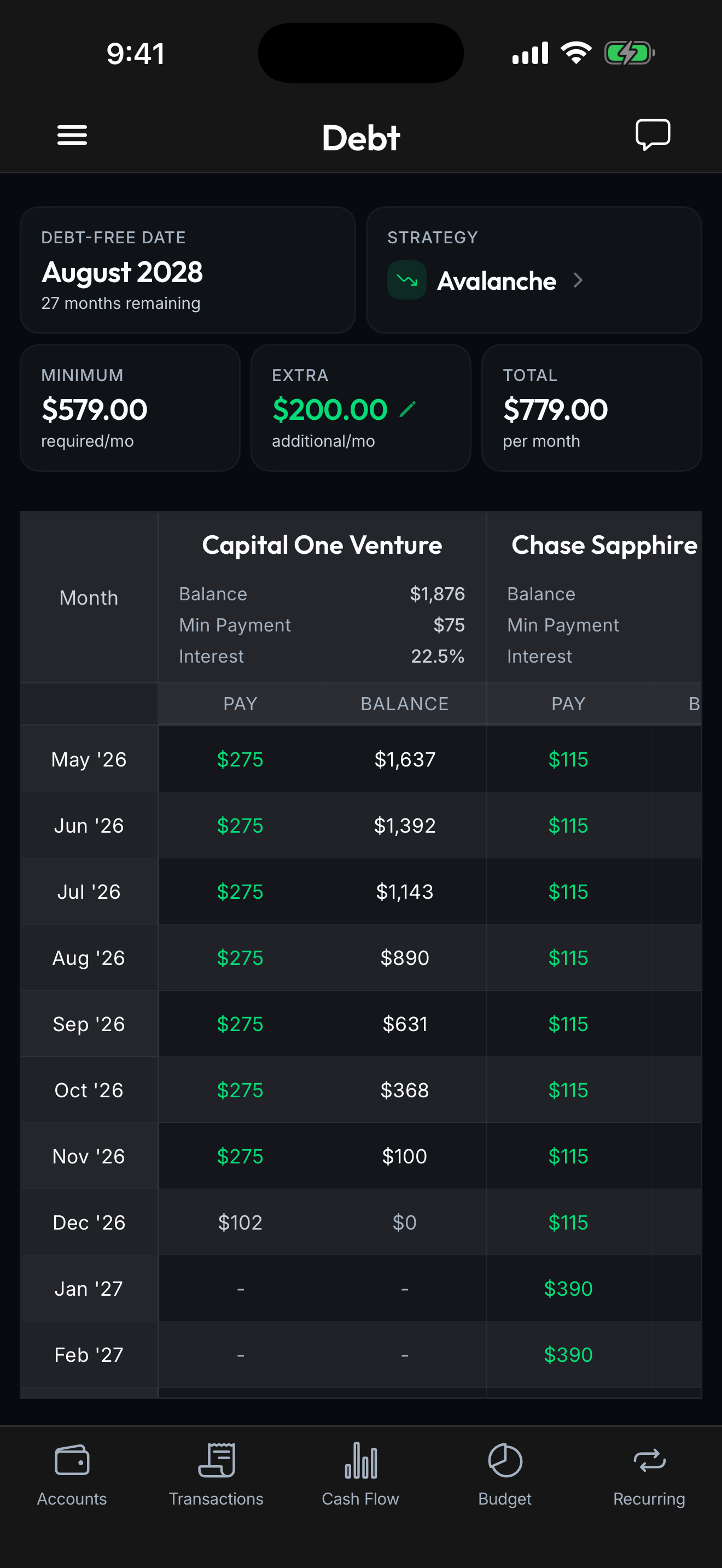
Why Spendify: Spendify calculates your exact debt-free date based on your real balances, interest rates, and payments. It compares the snowball vs. avalanche payoff strategies side-by-side in actual dollars saved. You can run what-if scenarios (extra $100/month, balance transfer, bonus) and see the timeline change instantly. $4.99/month or $49.99/year with a 7-day free trial. Available on iOS, Android, and the web.
Why YNAB as runner-up: YNAB is the gold standard for zero-based budgeting but has basic debt tools. If you want a debt app that doubles as a rigorous budget app and you have the patience to learn the zero-based method, YNAB works. $14.99/month or $109/year. See the full Spendify vs. YNAB comparison.
Skip for this use case: Copilot Money (no debt-free date calculation), Monarch (debt is a secondary feature), Rocket Money (subscription-focus), Empower (investment-focus).
Deeper reading: 8 best debt payoff apps in 2026 → · Debt snowball vs. avalanche →
Use case 2: “My partner and I want to manage money together”
Best pick: Monarch Money Runner-up: Spendify
Couples and families have two specific needs that most apps ignore: multiple people accessing the same data, and role-based permissions so partners can view everything while kids (or a bookkeeper) see only what they should.
Why Monarch: Built around collaboration from day one. Both partners get their own login, transactions are shared, categorization is shared, and you can assign owners to accounts. Clean, spousal-friendly interface. $14.99/month or ~$99/year. See how Spendify compares to Monarch.
Why Spendify as runner-up: Spendify has unlimited workspaces with role-based access (Owner / Admin / Viewer). Each person gets their own login, you control what each person sees, and you can have separate workspaces for personal + business + family, all in one subscription. Also $29/year cheaper than Monarch. Where Monarch wins: slightly more mature collaboration UX in 2026. Where Spendify wins: debt planning, unlimited separate workspaces, price.
Skip for this use case: YNAB (one workspace per subscription, literally doesn’t support a second user well), Copilot Money (single-user by design), Rocket Money (no collaboration).
Use case 3: “I want aggressive, zero-based budgeting”
Best pick: YNAB Runner-up: EveryDollar
Zero-based budgeting means every dollar you earn gets assigned a job before you spend it: rent, food, debt, savings, fun. If that philosophy appeals to you and you’re willing to invest time learning a system, one of these two.
Why YNAB: YNAB defined the modern zero-based budgeting category. The learning curve is real. Plan for 10 to 15 hours of setup and reading. But once you’re in the system, it’s unmatched for proactive money management. $14.99/month or $109/year.
Why EveryDollar: Dave Ramsey’s zero-based budgeting app. Free tier is manual-only (no bank sync), paid tier ($17.99/month, billed annually at $49.99/year in 2026) adds automatic tracking. Best for people who follow the Ramsey baby-steps methodology. Fewer features than YNAB but simpler to start.
Skip for this use case: Mint-style reactive tracking apps (Copilot, Monarch) are not built for zero-based. You can force it but the workflow fights you. Don’t bother.
Use case 4: “I want to kill recurring subscriptions I forgot about”
Best pick: Rocket Money Runner-up: Copilot Money
Rocket Money’s core value proposition is finding and canceling subscriptions you no longer use. It’s surprisingly effective. The average user finds $600/year of forgotten charges within the first month.
Why Rocket Money: Designed specifically for the subscription-audit use case. Automatically flags recurring charges, offers concierge cancellation (they call the service on your behalf), and negotiates bills for a fee. Free tier exists but is limited. Premium is $4 to $12/month (user-chosen pricing). See how Spendify compares to Rocket Money.
Why Copilot as runner-up: Copilot’s recurring-charge detection is excellent and more accurate than most. No concierge cancellation, you cancel manually, but you see every recurring charge clearly. $13/month or ~$95/year.
Skip for this use case: Apps that don’t emphasize recurring detection will miss subscriptions you’ve forgotten about. That’s most of them.
Use case 5: “I’m on iPhone and I want an Apple-native experience”
Best pick: Spendify Runner-up: Copilot Money
Apple Card, Apple Cash, and Apple Savings don’t work with most third-party finance apps because Apple restricts them to its own FinanceKit API. Only a handful of apps integrate natively.
Why Spendify: Integrates Apple FinanceKit natively: pulls Apple Card transactions, Apple Cash, and Apple Savings directly, alongside your Plaid-connected accounts. Available on iOS, Android, and the web (Copilot is Apple + Web only, no Android). $4.99/month or $49.99/year with a 7-day free trial.
Why Copilot as runner-up: Copilot was the first to integrate FinanceKit and arguably has the more Apple-polished design. The tradeoff is Copilot is iOS-only (no Android), more expensive, and doesn’t do debt planning. See how Spendify compares to Copilot.
Skip for this use case: YNAB, Monarch, Rocket Money, and Empower do not integrate FinanceKit. If Apple Card is where your main spending lives, these apps will miss a meaningful chunk of your transactions.
Use case 6: “I want a free option and I’m willing to enter data manually”
Best pick: Empower (for net worth) Runner-up: Undebt.it (for debt payoff specifically)
Mint’s free-with-ads model has not been replicated. The remaining free options are either single-purpose or heavily upsold.
Why Empower: Formerly Personal Capital, now Empower. Free net worth tracking, investment dashboard, and spending overview, with no feature-gating. The weakness: Empower sells wealth management services, so you’ll occasionally get calls from an advisor trying to sell you their $1M+ minimum investment product. Use it, ignore the outreach.
Why Undebt.it: If your goal is specifically debt payoff and you don’t want to connect your bank accounts, Undebt.it is a free web tool that calculates snowball/avalanche timelines. You enter your debts manually. No mobile app, no budgeting, just debt math. Genuinely useful for the narrow use case.
Skip for this use case: Rocket Money’s free tier, EveryDollar’s free tier, and Monarch’s trial are not sustainable long-term free options. Each eventually pressures you into a paid plan.
Use case 7: “I want to use AI to actually understand my spending”
Best pick: Spendify Runner-up: none. This is genuinely new ground
Most personal finance apps don’t have real AI. They have chart generators and maybe a “hey your spending is up” alert. A few have added ChatGPT-style chatbots that don’t actually see your data.
Why Spendify: Spendify is the first personal finance app with a Model Context Protocol (MCP) server, which means you can connect your Spendify account directly to Claude, ChatGPT, Cursor, or any MCP-compatible AI client. The AI then queries your real finances (30+ tools covering accounts, transactions, budgets, categories, merchants, recurring charges, and automation rules) through OAuth 2.1 with PKCE. Ask “why is my dining out up this month” and get a real analysis based on your actual transactions.
Why no clear runner-up: No other major personal finance app has shipped MCP support as of April 2026. Rocket Money, Monarch, YNAB, and Copilot all have chart-based insights but no way for external AI tools to access your finances in a structured, real-time way.
Read more about connecting your finances to AI via MCP →
Quick comparison table
Prices are USD, verified 2026-04-13. Features marked based on each product’s public feature list.
| App | Monthly | Yearly | Debt-free date | Snowball/avalanche | Couples | Apple FinanceKit | Android | AI / MCP |
|---|---|---|---|---|---|---|---|---|
| Spendify | $4.99 | $49.99 (7-day trial) | ✓ | ✓ side-by-side | ✓ unlimited workspaces | ✓ | ✓ | ✓ MCP |
| Monarch | $14.99 | ~$99 | No | Basic tracking only | ✓ | No | ✓ | No |
| YNAB | $14.99 | $109 | No | Basic | Limited (1 workspace) | No | ✓ | No |
| Copilot | $13 | ~$95 | No | No | No | ✓ | No | No |
| Rocket Money | $4 to $12 | No | No | No | No | No | ✓ | No |
| EveryDollar | $17.99 | $49.99 | No | No | No | No | ✓ | No |
| Empower | Free | No | No | No | No | No | ✓ | No |
| Undebt.it | Free | No | Estimate | ✓ (manual) | No | No | No | No |
The honest answer
If you were using Mint purely to see balances and categorize spending, any of these apps does that. The differentiator is what else you need.
If your primary goal is to pay off debt strategically, use Spendify. If you’re managing money with a partner, use Monarch or Spendify. If you want to learn proactive budgeting with a steep curve, use YNAB. If you want to kill forgotten subscriptions, use Rocket Money. If Apple Card is where your spending lives, use Spendify or Copilot. If you need a free option, use Empower (or Undebt.it for just debt).
Mint was a good free app that became a neglected free app. Its successor isn’t a single replacement. It’s a small set of focused, paid apps, each better than Mint at its particular thing.
Related reading
- 8 Best Debt Payoff Apps in 2026 (Ranked & Reviewed). If debt is your primary concern.
- Mint Shut Down: Now What?. History of the shutdown and how Intuit handled the transition.
- Debt Snowball vs. Avalanche: Which Method Pays Off Debt Faster?. If you’re choosing a payoff strategy.
- How to Create a Debt Payoff Plan That Actually Works. Once you’ve picked an app.
- Free Debt Payoff Calculator. Try the math without signing up.
Last updated: April 2026. We review and update this comparison quarterly to reflect pricing changes, new features, and app updates. Prices shown are USD and were verified at time of publication.