Best Apps to Pay Off Debt in 2026 (8 Ranked: Free & Paid)

Junior Y.
Founder, Spendify

The best debt payoff apps in 2026 are Spendify (best overall: exact debt-free date + strategy comparison + AI advisor, $4.99/mo or $49.99/yr), YNAB (best for zero-based budgeters, $14.99/mo), Monarch (best for couples, $14.99/mo), Rocket Money (best for subscription audits, $4-12/mo), and Undebt.it (best free option, manual entry only). Each is covered in detail below with actual tradeoffs.
Americans carry over $1.14 trillion in credit card debt and $1.77 trillion in student loans. If you’re part of that, the right debt payoff app can save you thousands in interest and years of payments.
We tested 8 of the most popular debt payoff apps in 2026: signing up, connecting accounts, entering debts, and using each one for real. This review covers what actually matters: payoff strategy support, bank sync reliability, pricing, and whether the app gives you a plan or just shows you data.
Disclosure: We built Spendify, so we’re biased. But we also used every app on this list before building our own, and we’ll be upfront about where competitors do something better. Where another app wins a category, we’ll say so.
How we evaluated each app
We scored every app on five criteria that matter most when you’re trying to get out of debt:
- Payoff strategy support: Does it offer snowball, avalanche, and other methods? Can you compare them side by side?
- Debt-free date: Does it calculate an actual date when you’ll be debt-free?
- Bank sync: Does it connect to your accounts automatically, or is everything manual?
- Full financial picture: Does it also handle budgeting, spending, and net worth, or do you need a second app?
- Price for value: Is it worth what you pay?
1. Spendify: Best Overall Debt Payoff App
Best for: People who want a debt payoff plan, budget tracking, and AI financial insights in one app.
Price: $4.99/month or $49.99/year ($4.17/month). 7-day free trial.
Platforms: iOS, Android, Web
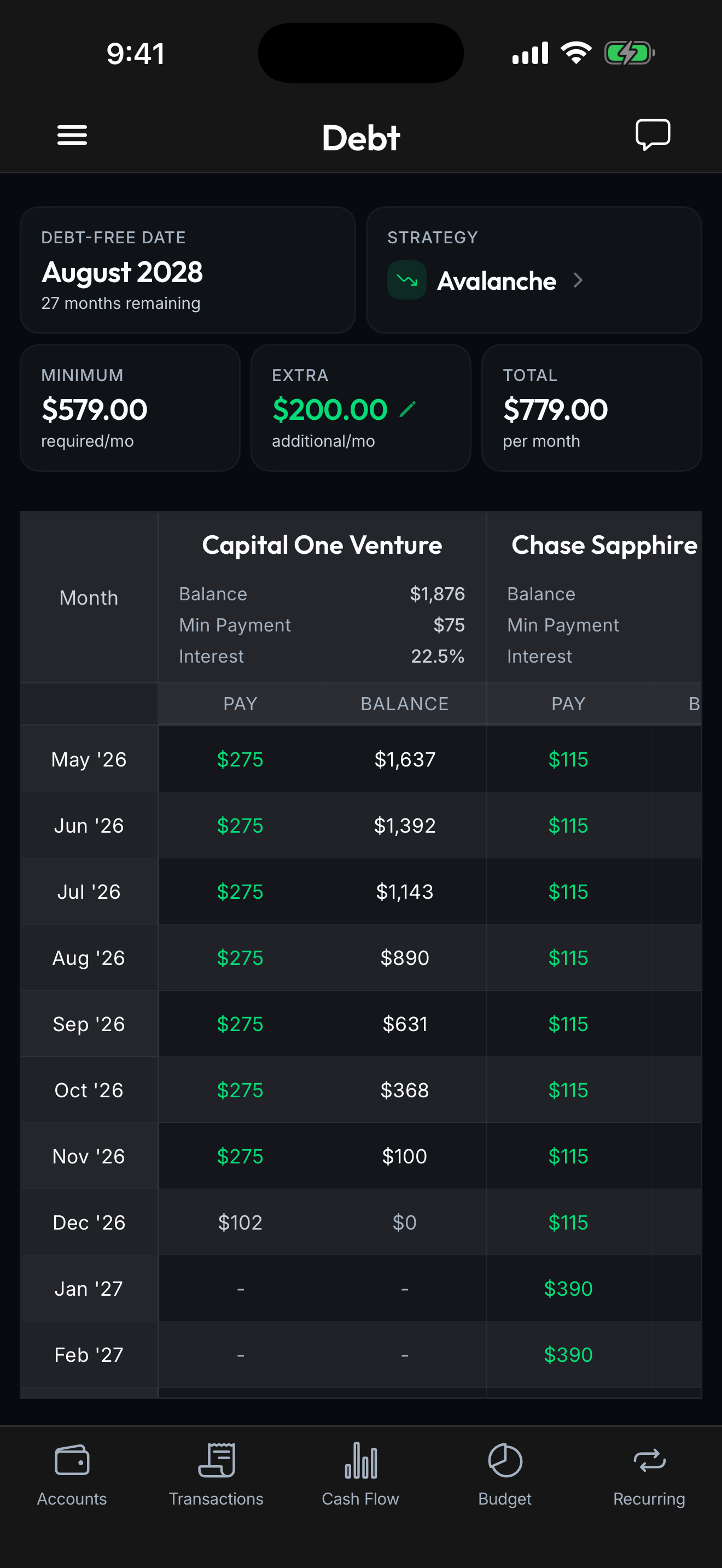
Our take: Spendify is the only app that combines a full debt payoff planner with automatic bank sync, budget tracking, and an AI financial advisor. Most apps make you choose between debt tools and budgeting. Spendify does both in one place.
What it does well:
- Exact debt-free date that updates in real time as you make payments
- Side-by-side strategy comparison of snowball, avalanche, and custom payoff methods with exact interest savings and time differences
- What-if scenarios: see how an extra $100/month, a tax refund, or a bonus changes your timeline
- Automatic bank sync with 13,000+ financial institutions via Plaid (plus Apple FinanceKit on iOS)
- Full budget tracking with spending categories, recurring charge detection, and net worth
- AI financial advisor that analyzes your actual data and answers questions about your finances
- Shared workspaces for couples and families with role-based access
- MCP server that connects your financial data to AI tools like Claude and Cursor
Where it falls short:
- Newer app, with a smaller community and fewer integrations than established players like YNAB
- No free tier (though the try Spendify free for 7 days)
- Android version launched recently, so iOS has had more polish time
Bottom line: If you want one app that tells you exactly when you’ll be debt-free, compares strategies with your real numbers, and also handles your budget, Spendify is purpose-built for that. The 7-day free trial makes it nearly risk-free to try.
2. YNAB (You Need A Budget): Best for Zero-Based Budgeting
Best for: People committed to the zero-based budgeting method who happen to have debt.
Price: $14.99/month or $109/year ($9.08/month). 34-day free trial.
Platforms: iOS, Android, Web
Our take: YNAB is the gold standard for zero-based budgeting. Its philosophy of “give every dollar a job” has genuinely changed how millions manage money. But it’s a budgeting tool first. Debt payoff is secondary.
What it does well:
- Best-in-class zero-based budgeting system with deep educational content
- Passionate community: subreddits, YouTube tutorials, podcasts devoted to the YNAB method
- Bank sync available (though many power users prefer manual entry for awareness)
- Goal tracking with target dates and funding progress
- Proven track record: loyal user base since 2004
- Web app in addition to mobile
Where it falls short:
- No dedicated debt payoff planner. You can track debt accounts, but there’s no strategy comparison (snowball vs. avalanche), no debt-free date calculator, and no what-if scenarios
- The learning curve is steep. YNAB’s method requires a philosophical buy-in that not everyone wants
- More expensive than most alternatives at $14.99/month
- No AI features or smart insights
- Better for budgeting people who happen to have debt than for debt-focused users
Bottom line: If you want to master budgeting and you’re willing to invest time learning the YNAB method, it’s excellent. But if your primary goal is getting out of debt as fast as possible, you’ll want a dedicated debt payoff planner alongside it. See the head-to-head breakdown in Spendify vs YNAB.
3. Monarch Money: Best for Couples & Families
Best for: Couples and families who want a comprehensive financial dashboard with modern design.
Price: $14.99/month or $99.99/year ($8.33/month). 7-day free trial.
Platforms: iOS, Android, Web
Our take: Monarch Money positioned itself as the premium Mint replacement, and it delivers on that promise. The interface is polished, investment tracking is strong, and it’s built for households managing money together. But it’s a general finance dashboard, not a debt payoff tool.
What it does well:
- Clean, modern interface that feels premium
- Strong investment tracking alongside budgets and spending
- Excellent for households managing money together
- Flexible budgeting that works with any philosophy (not locked into zero-based)
- Net worth tracking with good historical visualizations
- Cash flow forecasting
- Web app available
Where it falls short:
- Debt payoff tools are basic: no strategy comparison, no what-if scenarios, no debt-free date projection
- Positioned as a Mint replacement, not a debt payoff tool
- Most expensive option on this list at $14.99/month
- No AI financial advisor or smart analysis
- 7-day trial is short compared to YNAB’s 34 days
Bottom line: If you’re post-debt and want a great family financial dashboard, Monarch is one of the best. But if you’re actively trying to pay off debt, the lack of strategy comparison and payoff planning is a real gap. We break it down feature by feature in Spendify vs Monarch.
4. Rocket Money: Best for Subscription Management
Best for: People who want to cancel subscriptions and negotiate bills.
Price: Free (basic) or $6-12/month for premium. Premium price is variable.
Platforms: iOS, Android, Web
Our take: Rocket Money (formerly Truebill) has a massive user base and strong brand recognition. Its standout feature is subscription cancellation and bill negotiation. They’ll call your providers and try to lower your bills. The budgeting and tracking features are decent but not as deep as YNAB or Monarch.
What it does well:
- Subscription detection and cancellation: finds recurring charges you’ve forgotten about
- Bill negotiation service: they’ll try to lower your cable, internet, and insurance bills (takes a percentage of savings)
- Clean interface and good onboarding
- Bank sync with major institutions
- Basic budget tracking and spending categories
- Free tier available with basic tracking
Where it falls short:
- No debt payoff planner. No snowball or avalanche strategies, no debt-free date, no what-if scenarios
- Premium pricing is opaque: you “choose your price” between $6-12/month, which feels manipulative
- Bill negotiation takes a percentage of your savings (40-60% of the first year’s savings)
- Budgeting features are less robust than YNAB or Monarch
- No AI financial advisor
Bottom line: Rocket Money is great for finding and canceling forgotten subscriptions. But for debt payoff specifically, it doesn’t have the tools you need. Use it to free up money, then use a debt payoff app to deploy that money strategically. See Spendify vs Rocket Money for the full comparison.
5. EveryDollar: Best for Dave Ramsey Followers
Best for: People following Dave Ramsey’s Baby Steps method.
Price: Free (basic) or $17.99/month for premium (Ramsey+). 14-day trial.
Platforms: iOS, Android, Web
Our take: EveryDollar is Dave Ramsey’s budgeting app. If you follow the Baby Steps (debt snowball, $1,000 starter emergency fund, etc.), it’s designed around that framework. The free version is a solid manual budgeting tool. Bank sync requires the expensive premium tier.
What it does well:
- Designed specifically around Dave Ramsey’s Baby Steps
- Clean, simple zero-based budgeting interface
- Free tier is genuinely usable for manual budgeting
- Clear philosophy and structure if you follow the Ramsey method
- Debt snowball tracking built in (consistent with Baby Steps)
Where it falls short:
- Bank sync requires premium at $17.99/month: the most expensive premium tier on this list
- Only supports snowball method (no avalanche option, consistent with Ramsey philosophy but limiting)
- No what-if scenarios or debt-free date calculator
- No strategy comparison
- No AI features
- Deeply tied to the Ramsey ecosystem: if you don’t follow Baby Steps, the structure may feel constraining
Bottom line: If you’re a Dave Ramsey follower, EveryDollar integrates with the Baby Steps curriculum. But at $17.99/month for bank sync, it’s the most expensive option on this list, and the lack of strategy comparison means you can’t see if avalanche would save you money. Here’s Spendify vs EveryDollar side by side.
6. Undebt.it: Best Free Debt Calculator
Best for: People who want a free, web-based debt payoff calculator and don’t need bank sync.
Price: Free (basic) or $11.99/year for premium.
Platforms: Web only (no mobile app)
Our take: Undebt.it is the no-frills option that does one thing well: calculate your debt payoff. It offers more payoff strategies than any other tool on this list (including some uncommon ones like debt-to-interest ratio and highest balance). If you want a free calculator and don’t mind manual entry, it’s hard to beat.
What it does well:
- Most payoff strategies: snowball, avalanche, debt-to-interest ratio, highest balance, and several others (6+ methods)
- Completely free for the basic calculator
- Detailed amortization tables and payment schedules
- Premium tier is extremely affordable at $11.99/year
- No-nonsense interface focused on the math
Where it falls short:
- No bank sync: everything is manual entry
- No mobile app: web only, which means no notifications or on-the-go tracking
- No budget tracking, spending categories, or net worth
- No AI features or smart insights
- The interface is functional but dated
- You need a separate app for everything except the debt payoff calculation itself
Bottom line: Undebt.it is the best free debt calculator available. If you want to run the numbers and don’t need automated tracking, it’s a great tool. But if you want bank sync and budget tracking in the same app, you’ll need to pair it with something else.
7. Debt Payoff Planner (Mobile App): Best Simple Mobile Tracker
Best for: People who want the simplest possible debt tracker on their phone.
Price: Free with ads, or one-time $4.99 purchase to remove ads.
Platforms: iOS, Android
Our take: Debt Payoff Planner is a simple, focused mobile app. Enter your debts, pick snowball or avalanche, and see your payoff date. That’s pretty much it. If you want a basic calculator that lives on your phone, this is the cheapest paid option available (one-time purchase, not subscription).
What it does well:
- Simple and focused: enter debts, pick a strategy, see your payoff date
- Cheapest paid option at $4.99 one-time purchase
- Supports snowball and avalanche methods
- Clean mobile interface
- No subscription required
Where it falls short:
- No bank sync: manual entry only, which means you have to update balances yourself
- No budgeting, spending tracking, or net worth
- Limited strategy comparison (just snowball and avalanche, no side-by-side)
- No what-if scenarios
- No AI features
- It’s a calculator, not a financial management tool
Bottom line: Debt Payoff Planner is the cheapest way to get a debt payoff calculation on your phone. But without bank sync or budgeting, you’re manually updating everything and need another app for the rest of your finances. See Spendify vs Debt Payoff Planner for where automatic sync changes the math.
8. Empower (formerly Personal Capital): Best for Investment Tracking
Best for: People focused on investments and retirement who also have some debt.
Price: Free
Platforms: iOS, Android, Web
Our take: Empower is primarily an investment tracking and wealth management tool. The free version gives you a solid financial dashboard, and the paid advisory service manages your investments. Debt tracking exists but is minimal.
What it does well:
- Best-in-class investment tracking with portfolio analysis, fee analyzer, and retirement planner
- Free for personal use (the business model is upselling wealth management services)
- Bank sync and spending tracking
- Net worth tracking with good visualizations
- Cash flow analysis
Where it falls short:
- Essentially zero debt payoff features: no strategy comparison, no debt-free date, no what-if scenarios
- The app is designed to move you toward their paid investment advisory (minimum $100K assets)
- Budgeting features are basic compared to YNAB or Monarch
- Not designed for people focused on debt: it’s built for people building wealth
Bottom line: If you’re past the debt payoff stage and focused on growing investments, Empower is excellent and free. But if you’re actively paying off debt, it won’t help you. It doesn’t have the tools. See Spendify vs Empower for the debt-focused comparison.
Which debt payoff app should you pick?
The right app depends on what you’re actually trying to do:
If your #1 goal is paying off debt as fast as possible and you want automatic bank sync, strategy comparison, what-if scenarios, and budget tracking all in one place, Spendify is built specifically for this. Try free for 7 days.
If you want to master zero-based budgeting and you’re willing to invest time learning a methodology, YNAB’s system is proven and the community is incredibly helpful. Just know it’s a budgeting tool, not a debt payoff planner.
If you’re a couple or family managing money together and debt isn’t your main focus, Monarch Money has the best household financial dashboard.
If you need to cancel forgotten subscriptions and lower your bills, start with Rocket Money to free up cash, then use a debt payoff app to put that money to work.
If you follow Dave Ramsey’s Baby Steps, EveryDollar integrates with that framework. But the $17.99/month premium tier is expensive for bank sync.
If you want a free debt calculator and don’t mind manual entry, Undebt.it offers the most payoff strategies of any tool on this list.
If you want the cheapest mobile option, Debt Payoff Planner does the basics for a one-time $4.99 purchase.
If you’re focused on investments and are past the debt stage, Empower is free and excellent for portfolio tracking.
Frequently asked questions
What is the best app to pay off debt?
The best debt payoff app depends on your situation. For most people focused on getting out of debt, Spendify offers the most complete package: automatic bank sync, side-by-side strategy comparison (snowball vs. avalanche), what-if scenarios, and full budget tracking in one app. If you want a free option and don’t mind manual entry, Undebt.it is the best free debt calculator.
Is the debt snowball or avalanche method better?
Neither method is universally better. It depends on your specific debts. The avalanche method (paying highest interest first) saves the most money mathematically. The snowball method (paying smallest balance first) gives you faster psychological wins. The best approach is to compare both strategies with your actual numbers. Apps like Spendify and Undebt.it let you see the exact difference in months and dollars for your situation.
Are debt payoff apps safe to use?
Reputable debt payoff apps use bank-grade security. Apps that connect to your bank accounts typically use Plaid, the same secure service used by Venmo, Robinhood, and major banks. Look for AES-256 encryption, and make sure the app never stores your bank login credentials directly. Paid apps are generally safer because they don’t need to monetize your data through advertising.
Do I need a debt payoff app if I have a budgeting app?
Most budgeting apps (YNAB, Monarch, Rocket Money) don’t include dedicated debt payoff tools. They can track your debt balances, but they can’t compare payoff strategies, calculate your debt-free date, or show you what-if scenarios. If you’re serious about paying off debt strategically, a dedicated debt payoff planner saves you time and potentially thousands in interest.
How much should a debt payoff app cost?
Debt payoff apps range from free (Undebt.it, Empower) to $17.99/month (EveryDollar premium). Most paid options are $7-15/month. The average user saves hundreds to thousands of dollars in interest by choosing the right payoff strategy, so even a paid app typically pays for itself quickly. Spendify offers a 7-day free trial, making it essentially free to try.
Related reading
- Debt Snowball vs. Avalanche: Which Method Pays Off Debt Faster?: pick a strategy before you pick an app.
- How to Create a Debt Payoff Plan That Actually Works: the five steps to build your plan in whatever app you choose.
- Mint Shut Down: Now What?: if you’re migrating from Mint specifically.
- Free Debt Payoff Calculator: try the math without signing up.
Last updated: June 2026. We review and update this comparison quarterly to reflect pricing changes, new features, and app updates. Prices shown are USD and were verified at time of publication.