How to Build a Debt Payoff Plan: 5-Step Guide (2026)

Junior Y.
Founder, Spendify

A debt payoff plan takes five steps to build: (1) list every debt with balance, interest rate, and minimum payment; (2) pick a payoff strategy (snowball or avalanche); (3) calculate your exact debt-free date; (4) run what-if scenarios to find extra leverage; (5) track progress monthly. You can do all five with a spreadsheet, a free calculator like Undebt.it, or an automated app like Spendify. The steps are the same, only the tedium changes.
A debt payoff plan is not a budget. It’s not a spreadsheet you look at once. It’s a system that tells you exactly which debt to pay first, how much to pay each month, and when you’ll be completely debt-free, and then stays accurate as your numbers change.
Most people never build one, not because they’re lazy, but because creating a real plan means pulling numbers from multiple accounts, running math across different payoff methods, and keeping everything in sync as balances shift. Doing that by hand is genuinely tedious.
This guide is about how to set one up and keep it running, the implementation side. If you want to decide between the snowball and avalanche methods first, read our guide on debt snowball vs. avalanche and come back here to build the plan around your choice.
The five steps below apply whether you’re using a spreadsheet, a free calculator like Undebt.it, or an automated app like Spendify. The work is the same; the tooling just changes how much of it is manual.
Step 1: Get all your debts in one place
You can’t build a plan if you don’t know what you’re working with. Write down every debt you carry, not just the ones that stress you out, all of them.
For each debt, you need three numbers:
| What to record | Where to find it | Why it matters |
|---|---|---|
| Current balance | Bank/lender app or latest statement | Tells you how much you owe today |
| Interest rate (APR) | Same, look for “APR” or “interest rate” | Determines how fast the debt grows |
| Minimum monthly payment | Statement or autopay setup | The floor, you must pay at least this |
Common debts to include:
- Credit cards
- Student loans (federal and private, list each loan separately if they have different rates)
- Car loans
- Personal loans
- Medical bills (even if 0% interest, they still need to be paid)
- Buy-now-pay-later balances (Affirm, Klarna, Afterpay)
- Money owed to family or friends
Tip: If you’re using a finance app like Spendify, this step is automatic. Connect your accounts through Plaid and the app pulls in your balances, interest rates, and minimum payments from all your accounts. If you’re doing it manually, set aside 30 minutes to log into each account and gather the numbers.
Don’t skip debts because they’re small or 0% interest. They still take up cash flow each month, and including everything gives you the most accurate plan.
Step 2: Pick a strategy (and commit)
You need one method for ordering which debt to attack first. The two common ones:
- Snowball: smallest balance first. Quick emotional wins, keeps you engaged. Best if you’ve quit payoff plans before.
- Avalanche: highest interest rate first. Mathematically optimal, saves the most money. Best if your debts have very different rates (e.g., 5% student loan + 24% credit card).
Quick rule of thumb: If all your rates are within 2 to 3 percentage points of each other, pick snowball (easier, barely different). If you have a mix of low-rate loans and high-rate cards, pick avalanche (saves real money).
For the full breakdown with example numbers, see our guide on debt snowball vs. avalanche. For building your plan, the key is just: pick one, write it down, and don’t switch every month.
Step 3: Calculate your debt-free date
This is the step that changes everything. Not “I want to be debt-free someday.” An actual date, like March 2028.
When you know your exact debt-free date, something shifts. It stops being a vague wish and becomes a countdown. You can see it getting closer every month.
To calculate your debt-free date, you need:
- Your total debt (from Step 1)
- Interest rates on each debt
- Minimum payments for each debt
- How much extra you can pay per month beyond minimums
The math: Each debt’s payoff timeline depends on its balance, rate, and payment. The snowball and avalanche methods change the order, which changes how much total interest accumulates. For a single debt, the formula is straightforward. For multiple debts with different rates and the snowball effect of rolling payments, it gets complex fast.
Options for calculating (see our full comparison of debt payoff apps for pros/cons):
- Spreadsheet: Build an amortization schedule for each debt. Works but tedious, especially for what-if scenarios.
- Free calculator: Undebt.it lets you enter debts manually and see the payoff timeline. Good if you don’t need bank sync.
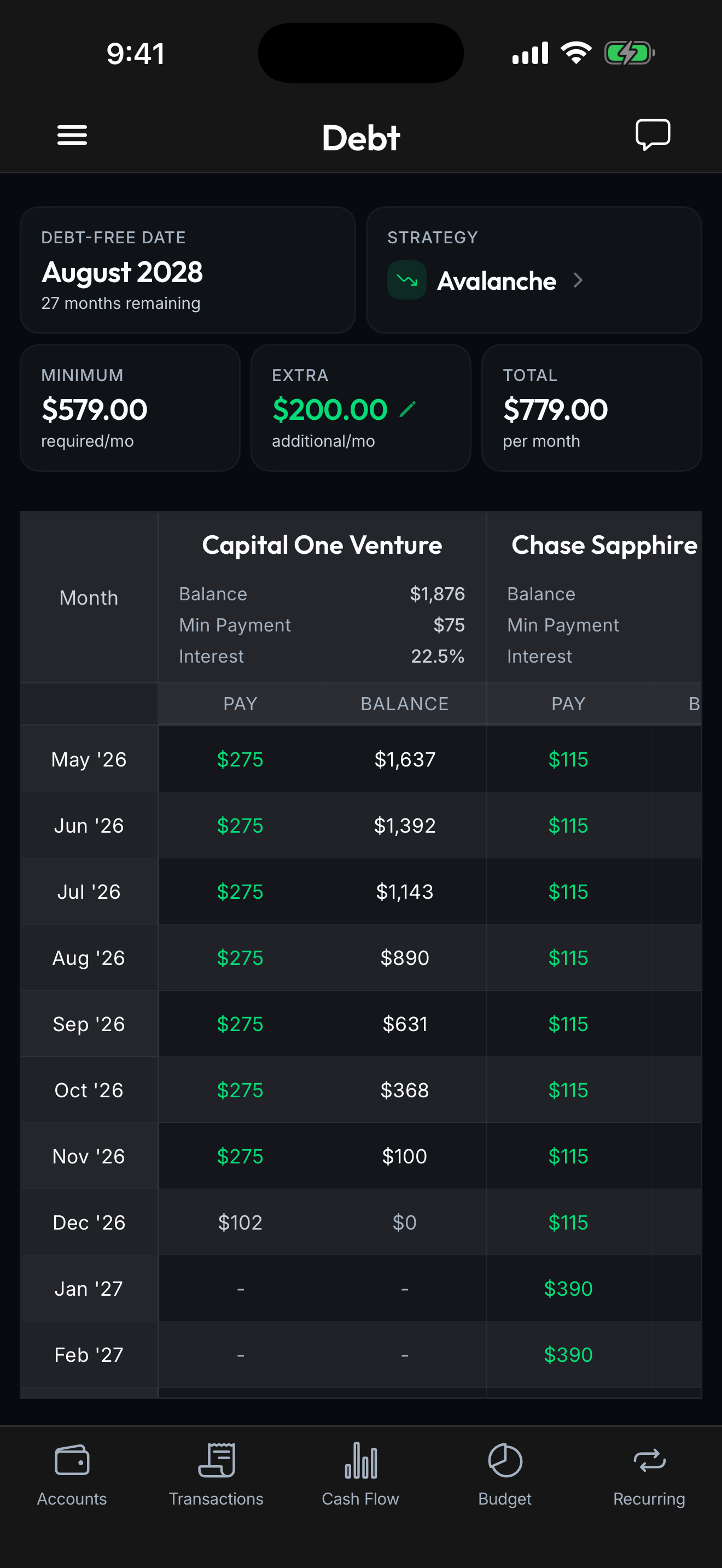
- Debt payoff app: Spendify connects to your bank accounts and calculates your debt-free date automatically with both snowball and avalanche strategies side by side.
Your debt-free date will change as you make payments, add extra payments, or take on new debt. That’s normal. What matters is having a target.
Step 4: Run the what-if scenarios
This is where debt payoff planning gets interesting, and where most people see the biggest motivation boost.
What-if scenarios to try:
-
Extra $100/month: What if you cut one subscription and put that money toward debt? On a $15,000 credit card at 24%, an extra $100/month could save you over $3,000 in interest and get you debt-free a year sooner.
-
Tax refund or bonus: What if you put a $2,000 tax refund toward your highest-rate debt? You might move your debt-free date up by 4-6 months.
-
Side income: What if you earn an extra $500/month from a side gig for 6 months? That $3,000 total could eliminate a small debt entirely and accelerate everything else.
-
Raise or promotion: What if you commit half of a raise to debt? This is one of the most powerful moves because it redirects money before you get used to spending it.
The point isn’t to pressure yourself into doing all of these. It’s to see what’s possible, and then pick the scenarios that feel realistic for your life.
Most people never run these numbers because the math is tedious. This is where apps and calculators earn their keep. Plug in the scenario, see the impact instantly.
Step 5: Track your progress and stick with it
The plan is done. Now you need to execute it, and that means tracking your progress monthly.
What to track each month:
- Balance updates: Are your balances going down as expected?
- Extra payments: Did you make any extra payments this month?
- Interest paid vs. saved: How much interest did you avoid this month by paying more than minimums?
- Debts eliminated: Celebrate every debt that hits $0. Each one is a real accomplishment.
- Debt-free date movement: Is your target date getting closer, staying the same, or moving further out?
Why tracking matters: The #1 reason people abandon their debt payoff plan is they can’t see the progress. When you’re making payments every month but the balance barely moves (because interest keeps accruing), it feels hopeless. Tracking metrics beyond just the balance, like total interest saved and debts eliminated, tells a different, more motivating story.
How to track:
- Manual spreadsheet: Free but requires discipline to update monthly
- Free calculator: Update balances in Undebt.it periodically
- Automated app: Spendify syncs with your accounts automatically, so your progress updates in real time without manual entry
Celebrate milestones. Every debt paid off deserves recognition. Every $1,000 in interest saved is real money in your pocket. Don’t just grind through it. Acknowledge the wins along the way.
How long does it take to pay off $10,000 in debt?
This is the question every debt payoff plan answers, and the answer depends on three variables: balance, APR, and how much extra you can pay above the minimum.
Worked example: $10,000 on a credit card at 22% APR with a $250 minimum:
| Extra payment per month | Total months to debt-free | Total interest paid |
|---|---|---|
| $0 (minimum only) | ~64 months (5y 4m) | ~$5,920 |
| $100 | ~37 months (3y 1m) | ~$3,030 |
| $250 | ~24 months (2y) | ~$1,860 |
| $500 | ~15 months | ~$1,090 |
Two things jump out. First, paying only the minimum on a $10,000 balance at 22% APR costs you almost $6,000 in interest and takes more than 5 years. Second, even an extra $100/month, one canceled subscription, one fewer takeout meal per week, cuts the timeline by 2+ years and saves nearly $3,000.
A $20,000 balance at the same rate roughly doubles every number above. A $5,000 balance roughly halves them. The structure of the math is the same; only the scale changes.
The other variable is APR. The same $10,000 balance at 7% APR (typical for a personal loan or a low-rate student loan) instead of 22% changes the picture entirely:
| $10,000 at 7% APR, $250 minimum | Months to debt-free | Total interest |
|---|---|---|
| Minimum only | ~46 months (3y 10m) | ~$1,520 |
| Plus $100/month | ~30 months | ~$985 |
Same $250 minimum, same balance, same extra payment, different APR, and the total interest difference is dramatic. This is why the avalanche method puts high-APR debt first: every month on a 22% card costs you ~10x what a month on a 7% loan costs.
Run your own numbers in the free debt payoff calculator to see the table for your exact balances, rates, and extra payment.
Common mistakes that derail debt payoff plans
Trying to pay off everything at once. Don’t spread extra payments across all debts equally. Focus on one debt at a time (using your chosen strategy) while paying minimums on the rest. Focused effort eliminates debts faster.
Not accounting for interest. If you only look at principal balances, your timeline will be off. Interest accrues monthly and makes the payoff take longer than you’d expect. Use a calculator or app that factors in interest.
Ignoring small debts. A $200 medical bill at 0% feels trivial, but it’s still taking cash flow each month. Including it in your plan means you’ll free up that payment sooner.
Not adjusting the plan. Life happens. You’ll get unexpected expenses, windfalls, and income changes. Review your plan monthly and adjust. A plan that doesn’t adapt isn’t a plan.
Going it alone. If you have a partner, involve them. Shared financial goals are more motivating and more effective than solo efforts. Consider an app with shared workspaces so you’re both looking at the same numbers.
The bottom line
A debt payoff plan comes down to five things: knowing what you owe, picking a strategy, calculating your debt-free date, running what-if scenarios to find extra leverage, and tracking your progress monthly.
You can do all of this with a spreadsheet if you have the patience. Or you can use a free calculator or an app that automates it. The important thing is having a plan at all, because any plan beats no plan.
Related reading
- Debt Snowball vs. Avalanche: Which Method Pays Off Debt Faster?: full breakdown with example numbers to help you pick a strategy.
- 8 Best Debt Payoff Apps in 2026 (Ranked & Reviewed): how Spendify compares to YNAB, Monarch, Rocket Money, EveryDollar, and others.
- Mint Shut Down: Now What?: best alternatives for former Mint users migrating to a new payoff planner.
- Free Debt Payoff Calculator: enter your debts and see your debt-free date without signing up.
Last updated: April 29, 2026.