Debt Snowball vs. Avalanche: Which Pays Off Faster? (2026)

Junior Y.
Founder, Spendify

The debt snowball pays off your smallest balance first for faster psychological wins. The debt avalanche pays off your highest interest rate first to save the most money. Avalanche is mathematically optimal; snowball has a higher completion rate in behavioral studies. Pick avalanche if your interest rates vary by more than 5 percentage points (typical when you have credit cards plus student loans). Pick snowball if all your rates are similar or you’ve abandoned debt payoff plans before.
Want to compare both with YOUR debts? Use the free debt payoff calculator → to see your debt-free date and total interest paid under each strategy, side by side, with your actual balances and rates.
Both work. Both have helped millions of people become debt-free. This guide explains exactly how each method works, runs the real math on example scenarios, and helps you decide which one fits your situation.
What is the debt snowball method?
The debt snowball method pays off your debts from smallest balance to largest, regardless of interest rate.
How it works:
- List all your debts from smallest balance to largest
- Make minimum payments on everything except the smallest debt
- Throw every extra dollar at the smallest debt
- When the smallest debt is paid off, roll that payment into the next smallest
- Repeat until all debts are gone
The snowball gets its name from the way your payments “snowball”: as each debt is eliminated, the money you were paying toward it rolls into the next debt, so your payments get bigger over time.
The psychology behind it: The snowball method was popularized by Dave Ramsey, and his reasoning is behavioral, not mathematical. Paying off a small debt quickly gives you a win. That win motivates you to keep going. Research backs this up: a 2016 study published in the Harvard Business Review found that people who focused on paying off small accounts first were more likely to eliminate their overall debt than those who focused on interest rates.
Who it’s best for:
- People with multiple small debts who want quick wins
- People who are motivated by visible progress
- Situations where the interest rate differences between debts are small
- Anyone who has tried and failed to stick with a debt payoff plan before
What is the debt avalanche method?
The debt avalanche method pays off your debts from highest interest rate to lowest, regardless of balance.
How it works:
- List all your debts from highest interest rate to lowest
- Make minimum payments on everything except the highest-rate debt
- Throw every extra dollar at the highest-rate debt
- When that debt is paid off, roll the payment into the next highest rate
- Repeat until all debts are gone
The math behind it: The avalanche method is mathematically optimal. By attacking the highest interest rate first, you minimize the total interest you pay over the life of your debts. Every dollar that goes to a high-interest debt stops that dollar from accumulating more interest.
Who it’s best for:
- People with a wide spread in interest rates (e.g., a 6% student loan and a 24% credit card)
- People who are motivated by saving money
- People with the discipline to stick with a plan even when early progress feels slow
- Situations where the highest-interest debt also has a large balance (the savings can be substantial)
A real example: snowball vs. avalanche with actual numbers
Let’s compare both methods with a common debt scenario. Say you have four debts and can put $500/month total toward them:
| Debt | Balance | Interest Rate | Minimum Payment |
|---|---|---|---|
| Store credit card | $800 | 22% | $25 |
| Visa credit card | $4,500 | 19.99% | $90 |
| Car loan | $8,200 | 6.5% | $275 |
| Student loan | $12,000 | 5.8% | $110 |
Total debt: $25,500 | Total minimum payments: $500/month
In this scenario, extra payment budget is $0 beyond minimums (all $500 goes to minimums). But what if you could find an extra $200/month? Here’s how the two strategies compare:
Snowball order (smallest to largest balance):
- Store credit card ($800)
- Visa credit card ($4,500)
- Car loan ($8,200)
- Student loan ($12,000)
Avalanche order (highest to lowest rate):
- Store credit card ($800 at 22%)
- Visa credit card ($4,500 at 19.99%)
- Car loan ($8,200 at 6.5%)
- Student loan ($12,000 at 5.8%)
In this case, both methods happen to follow the same order: the smallest balance also has the highest rate. That’s not always the case, but when it is, you get the best of both worlds.
Now consider a different scenario where the methods diverge:
| Debt | Balance | Interest Rate | Minimum Payment |
|---|---|---|---|
| Medical bill | $1,200 | 0% | $100 |
| Personal loan | $3,000 | 9% | $150 |
| Credit card | $7,500 | 24.99% | $200 |
| Student loan | $18,000 | 6.8% | $250 |
Snowball order: Medical bill → Personal loan → Credit card → Student loan
Avalanche order: Credit card → Personal loan → Student loan → Medical bill
With $800/month total and $100 extra:
| Snowball | Avalanche | Difference | |
|---|---|---|---|
| Debt-free date | ~36 months | ~34 months | Avalanche is 2 months faster |
| Total interest paid | ~$4,800 | ~$3,900 | Avalanche saves ~$900 |
| First debt eliminated | Month 3 (medical bill) | Month 11 (credit card) | Snowball’s first win is 8 months earlier |
This is the core trade-off: the snowball gives you that first win in 3 months, but the avalanche saves you $900 and 2 months overall.
When the snowball wins
The snowball isn’t just about feelings. There are real scenarios where it’s the better choice:
1. When interest rates are similar. If all your debts are between 5-8% interest, the avalanche’s mathematical advantage shrinks to almost nothing. In that case, the psychological benefit of quick wins outweighs the marginal interest savings.
2. When you’ve quit before. If you’ve started a debt payoff plan and stopped because it felt hopeless, the snowball’s quick wins might be exactly what you need. A paid-off debt in month 2 beats a mathematically optimal plan you abandon in month 4.
3. When you have many small debts. If you have five debts under $1,000 and two big ones, the snowball clears the clutter fast. Going from 7 debts to 2 debts in a few months simplifies your financial life and reduces the mental overhead of managing multiple payments.
4. When you need to free up cash flow. Each time you eliminate a debt, you free up its minimum payment. If you’re tight on cash and need breathing room, eliminating small debts quickly gives you more monthly flexibility.
When the avalanche wins
1. When you have one debt with a much higher rate. A 24% credit card alongside 5-7% loans is costing you real money every month. The avalanche attacks this immediately.
2. When the high-rate debt also has a small balance. This is the best case: you get quick wins AND save on interest. No trade-off needed.
3. When you’re disciplined and motivated by math. If seeing “$3,200 in interest saved” motivates you more than “1 debt paid off,” the avalanche aligns with how your brain works.
4. When you’re carrying a lot of debt. The bigger your total debt, the more interest accumulates, and the more the avalanche’s advantage compounds. On $50,000+ in debt, the avalanche can save thousands compared to the snowball.
Avalanche vs snowball for student loans
Student loans deserve their own section because the math usually points one way: if student loans are your only debt, the avalanche method’s advantage is small. Most federal student loans cluster in a tight rate band (4-7%), so attacking the highest-rate loan first saves less than people expect, typically a few hundred dollars over the life of the loans.
The avalanche wins decisively when you have student loans plus credit card debt. A 6.5% federal Direct Loan and a 24% Visa balance aren’t in the same league. The avalanche says attack the card first, and the math is brutal in its favor (often $1,000+ saved per $5,000 of credit card balance over the typical payoff period).
A few student-loan-specific notes:
- List each loan separately, not just one combined “student loan” line. Federal direct loans almost always have multiple disbursements at different rates. The avalanche needs the rate-by-rate view.
- Don’t sacrifice income-driven repayment. If you’re on IBR, PAYE, or another income-driven plan, throwing extra money at the loan in a payoff race can hurt you. You may be eligible for forgiveness on whatever’s left in 20-25 years, and prepaying defeats that. Run the math both ways. (See our SAVE plan deadline guide → for context on the current federal repayment changes.)
- Private refinancing is a separate decision, not part of snowball or avalanche. Refinancing trades federal protections for a lower rate; do it only after you’ve decided you don’t need IBR/PSLF.
For a pure snowball/avalanche question on a multi-loan student-loan portfolio, the avalanche typically wins by 1-3 months and a few hundred dollars. If you’re motivated by ticking loans off your list, the snowball’s behavioral edge can still be the right call.
The hybrid approach: why not both?
Some financial advisors recommend a hybrid approach:
- Start with snowball: pay off 1-2 small debts to build momentum and simplify your payment schedule
- Switch to avalanche: once you’ve got some wins under your belt and fewer accounts to manage, attack the highest interest rates
This gives you the psychological boost of early wins AND the mathematical efficiency of the avalanche for the long haul. It’s not a commonly discussed approach, but for many people it’s the practical best of both worlds.
The method that matters most: making extra payments
Here’s what most snowball-vs-avalanche debates miss: the biggest factor in how fast you pay off debt isn’t which method you pick. It’s how much extra you can throw at your debt each month.
The difference between snowball and avalanche on $25,000 in debt might be $500-2,000 in interest. The difference between paying minimums and adding $300/month extra could be $10,000+ in interest and years of payments.
Focus your energy on finding extra money (cutting expenses, increasing income, selling things) before optimizing which method to use. Both methods crush debt faster than just paying minimums.
How to figure out which method is right for YOUR debts
The only way to know which method saves you more time and money is to run the numbers on your actual debts. A general rule won’t tell you how much YOU’LL save.
You need to compare:
- Your debt-free date with snowball vs. avalanche
- Total interest paid with each method
- When you’ll get your first debt eliminated
- How extra payments change each scenario
You can do this three ways:
- Use our free debt payoff calculator: enter your debts manually and see the exact debt-free date and total interest under each strategy. No signup required.
- Use a spreadsheet: works but tedious, especially for what-if scenarios.
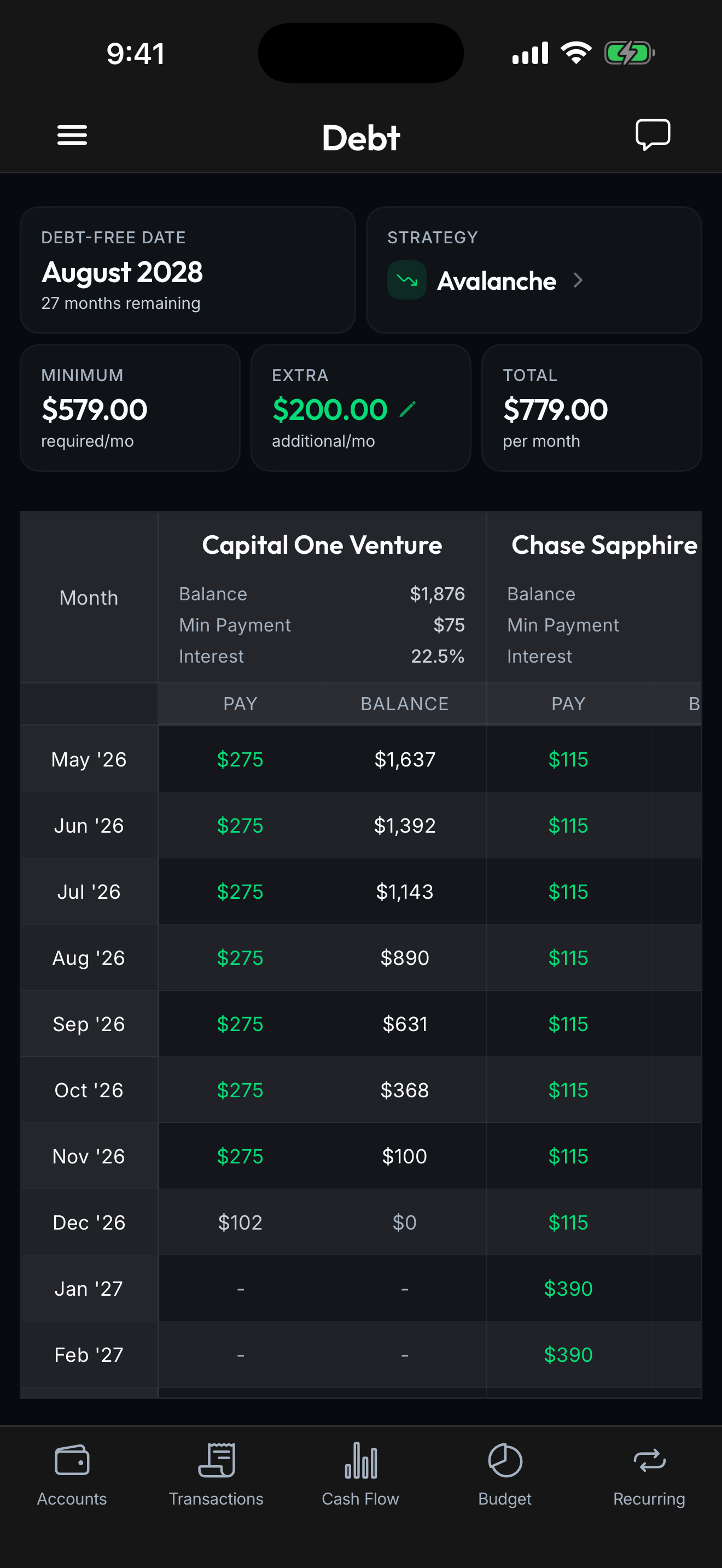
- Use a connected app like Spendify: connects to your bank accounts and runs both strategies automatically against your real balances, rates, and payments. No manual entry needed.
The point is: don’t guess. Run your numbers and make the decision based on data.
What about other payoff strategies?
Snowball and avalanche are the two most popular methods, but they’re not the only options:
Debt-to-interest ratio: Prioritizes debts with the highest ratio of balance to interest rate. It’s a middle ground between snowball and avalanche that some people find intuitive.
Highest balance first: Attacks the largest debt first. Not common and usually not mathematically optimal, but some people prefer to get the biggest weight off their shoulders.
Custom order: You pick the order based on your own priorities. Maybe you want to eliminate a debt tied to an ex, or pay off a loan from a family member first for relationship reasons. Personal factors matter.
Frequently asked questions
Is the debt avalanche always better than the snowball?
Not always. The avalanche saves more money mathematically, but the snowball has a higher success rate in behavioral studies. If you’re likely to quit a plan that doesn’t show quick progress, the snowball’s early wins can keep you on track. The best method is the one you actually stick with.
How much does the snowball vs. avalanche difference actually matter?
It depends on your debts. If your interest rates are all similar (within 2-3 percentage points), the difference is minimal, maybe a few hundred dollars. If you have a mix of low-rate loans (5-7%) and high-rate credit cards (20%+), the avalanche could save you thousands.
Can I switch methods partway through?
Absolutely. There’s no rule that says you have to commit to one method forever. Many people start with snowball to build momentum, then switch to avalanche once they’re in the groove. The important thing is to have a plan and stick with it. Any plan beats no plan.
Should I use the snowball or avalanche for student loans?
It depends on whether your student loans are your highest-rate debt. If you have credit card debt at 20%+ alongside student loans at 5-7%, the avalanche says attack the credit cards first (and it’s right, the rate difference is huge). If student loans are your only debt, the choice between snowball and avalanche depends on whether you have multiple loans with different balances and rates.
Do I need an app, or can I do this with a spreadsheet?
You can absolutely do this with a spreadsheet. But the math is tedious, especially for what-if scenarios and tracking progress over months. Apps automate the calculations and keep your plan updated as you make payments. For a free option, Undebt.it handles the math. For automatic bank sync and budget tracking alongside your debt plan, Spendify does it in one app.
Related reading
- How to Create a Debt Payoff Plan That Actually Works. Once you’ve picked a strategy, here’s how to build the plan around it.
- 8 Best Debt Payoff Apps in 2026 (Ranked & Reviewed). Apps that let you compare both strategies side by side with your real numbers.
- Mint Shut Down: Now What?. If you’re looking for a replacement that handles debt planning properly.
- Free Debt Payoff Calculator. Enter your debts and see the exact difference between snowball and avalanche.
Last updated: April 29, 2026. This guide is for educational purposes and doesn’t constitute financial advice. For advice specific to your situation, consult a certified financial planner.