Student Loan Payoff Calculator: The 2026 Guide to Actually Getting Out of Debt

Junior Y.
Founder, Spendify

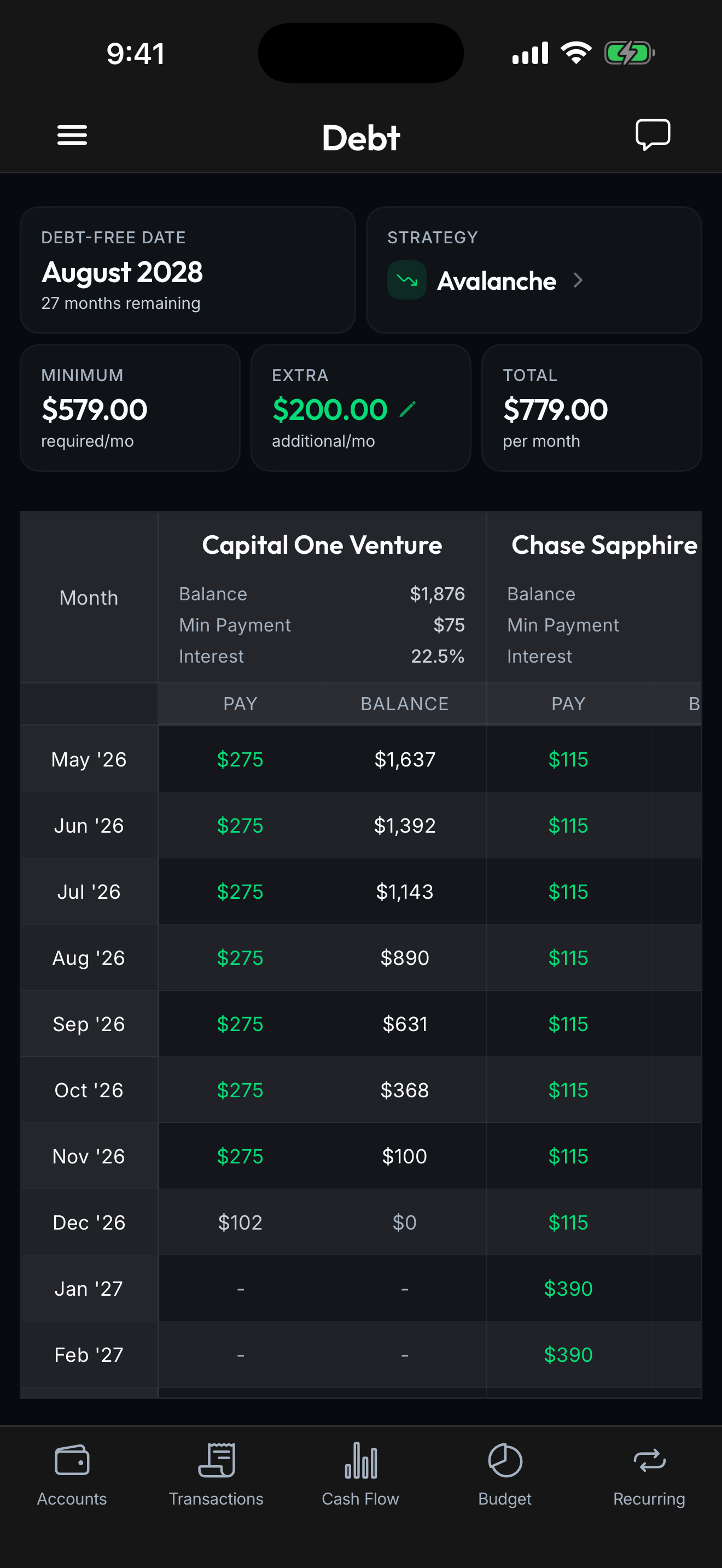
A student loan payoff calculator tells you three things: the exact month you’ll be debt-free, total interest you’ll pay over the life of the loan, and how much a specific extra payment changes both numbers. Use Spendify’s free debt payoff calculator. It handles student loans alongside any other debts you have, shows snowball and avalanche side-by-side, and doesn’t require signup for the basic math.
Americans owe roughly $1.77 trillion in student loans. If you’re paying the standard federal 10-year plan, you’re paying way more in interest than you need to. If you’re on income-driven repayment, you’re extending the balance for another decade. And if you have private loans, interest rates of 8 to 14% mean every extra dollar saves meaningful money.
This guide walks through how to actually use a payoff calculator for student loans specifically: what numbers to enter, what the output means, and how to act on it.
Before you calculate: gather these numbers
You need four data points for each student loan. Get them from the National Student Loan Data System (NSLDS) for federal loans, or your private lender’s statement for private loans.
- Current balance: the actual amount you owe today, not the amount you originally borrowed.
- Interest rate (APR): each loan has its own rate. Federal loans are fixed; private loans may be fixed or variable.
- Minimum monthly payment: what your lender requires.
- Loan type: federal subsidized, federal unsubsidized, federal PLUS, or private. This matters for strategy, not for the math.
Common gotchas:
- Federal consolidation loans can mask multiple underlying interest rates. Pull the details from studentaid.gov.
- Private loans with variable rates need to be checked quarterly; rates can move 2 to 3% over a year.
- Income-driven repayment “minimum” is not the loan’s actual minimum. It’s a calculated number based on your income.
Step 1: Enter your loans (one row per loan)
Don’t aggregate. If you have 6 federal loans and 2 private loans, enter 8 rows. Calculators that force you to combine loans give you wrong answers, because they average the interest rates.
In Spendify’s calculator, add each loan separately with its specific rate and balance. The calculator will then model the payoff as a multi-loan system, which matches reality.
Step 2: Run both strategies
The debt avalanche (highest rate first)
On student loans, avalanche usually means attacking private loans or grad PLUS loans first, because they typically have the highest rates (8 to 14% private, 8%+ grad PLUS), while federal undergraduate loans are 4 to 6%.
Example: If you have a $30,000 private loan at 10% and a $60,000 federal loan at 5%, the avalanche attacks the $30K private loan first even though it’s half the balance. You save thousands in interest.
The debt snowball (smallest balance first)
Snowball pays off the smallest loan first regardless of rate. For student loans, this often means paying off a tiny $1,500 subsidized loan before touching the big $40,000 private loan at 9%.
Snowball works if: You have a history of giving up on payoff plans, or your loans are all at similar rates.
Avalanche works if: Your rates vary by more than 3 percentage points (very common with a federal + private mix). The math advantage is usually $5,000 to $20,000 over the life of the loans.
For a deeper comparison with example numbers, see our guide on debt snowball vs. avalanche.
Step 3: Model what-if scenarios
The calculator’s most important feature is what-if modeling. This is where people find real money.
Try these scenarios:
- Extra $100/month toward the highest-rate loan. On a $50,000 balance at 7%, this pulls in your debt-free date by 3+ years and saves $8,000+ in interest.
- Lump sum from a tax refund or bonus. A $3,000 tax refund applied once (to the highest-rate loan) typically saves more than $1,500 in interest over the life of the loan, a 50% return.
- Continuing your current payment after one loan is paid off. When you pay off a $200/month loan, most people redirect that money to other spending. If you instead apply it to the next highest-rate loan, your total payoff accelerates dramatically. This is the “snowball effect” that gives the strategy its name.
- Refinancing to a lower rate. Enter your current loans, then enter a hypothetical refinanced loan with a lower rate. The difference is what refinancing would save you. Weigh against federal protections you’d give up.
- Switching to bi-weekly payments. Paying half your monthly amount every 2 weeks means 26 half-payments = 13 full payments per year instead of 12. This alone typically pulls payoff 1 to 2 years earlier with zero extra outlay.
Step 4: Federal vs. private loan decisions the calculator can’t make
A payoff calculator is math. Some student loan decisions are policy.
Public Service Loan Forgiveness (PSLF). If you work for a qualifying employer (government, 501(c)(3) nonprofit) and make 120 qualifying payments on an income-driven plan, your remaining federal balance is forgiven tax-free. If you’re 6 years into PSLF on a $150,000 balance, the “right” strategy is paying minimums forever until year 10, not aggressive payoff. Calculators don’t know this. You do.
Income-driven repayment (IDR). SAVE, PAYE, IBR, and ICR plans cap your monthly payment at a percentage of discretionary income. After 20 to 25 years of qualifying payments, remaining federal balance is forgiven (currently tax-free under 2025 tax law). If your balance is >2x your annual income and unlikely to change, IDR + forgiveness may beat aggressive payoff even without PSLF.
Federal protections. Deferment, forbearance, and pause-during-unemployment only exist on federal loans. Once you refinance to private, those are gone. Calculate the interest savings against the peace-of-mind value.
The honest rule: Use the calculator for private loans and high-rate federal loans (6%+) where the math clearly favors payoff. For low-rate federal loans (≤5%) where forgiveness or protection is even a possibility, talk to a student-loan-specific advisor before paying extra.
Step 5: Build the plan, then track it
Once you know which loan to attack and how much extra you can pay, build the plan and stick with it.
Options for tracking:
- Spreadsheet. Free but manual. Every payment means updating balances. Every rate change means redoing formulas.
- Undebt.it. Free web tool. Good payoff math, no bank sync, no ongoing tracking. You update balances manually each month.
- Spendify. Connects to your loan accounts via Plaid, auto-updates balances, tracks your debt-free date in real-time, and lets you run what-if scenarios without rebuilding spreadsheets. $4.99/month or $49.99/year with a 7-day free trial.
For the full comparison of debt payoff apps, see 8 Best Debt Payoff Apps in 2026 (Ranked & Reviewed).
Common mistakes with student loan payoff
Paying extra on subsidized loans while you’re in school. If you’re still enrolled at least half-time, subsidized federal loans don’t accrue interest. Any extra payment in this window is wasted leverage. Attack unsubsidized or private loans first.
Refinancing federal to private to save 0.5%. If the rate difference is under 1%, you’re giving up federal protections for minimal savings. Not worth it.
Paying off the “emotional” loan first. People often want to pay off the loan from their most-hated program or year first. That’s snowball at best, and pure emotion at worst. The calculator tells you what’s optimal. Decide whether your emotions are worth the extra interest.
Not recalculating when rates change. Variable-rate private loans shift over time. An 8% loan in 2024 may be 11% in 2026. Re-run the calculator quarterly; the payoff order may change.
Treating all federal loans the same. Federal unsubsidized loans (direct or grad PLUS) and federal subsidized loans often have different rates, sometimes 2+ percentage points apart. Don’t aggregate them. The calculator needs each row.
Quick reference: when to pay extra on student loans
| Your situation | Recommended action |
|---|---|
| Have private loans at 7%+ | Pay minimums elsewhere, attack private loans first |
| Have federal loans, working PSLF-eligible job, >6 years in | Pay the minimum on IDR. Extra payments may be forgiven anyway. |
| Mix of federal + private, stable high income | Refinance private if you can save ≥1.5%; attack the highest-rate loan with extras |
| Federal loans only, low-to-mid income, income-based plan | Check IDR forgiveness math first. Aggressive payoff may not be optimal. |
| In school, loans accruing interest | Pay interest-only if possible to stop capitalization; calculate full payoff post-graduation |
| Have credit card debt AND student loans | Attack credit cards first (always higher rate). Student loan minimums only until cards gone. |
Related reading
- 8 Best Debt Payoff Apps in 2026 (Ranked & Reviewed): app options for tracking student loan payoff automatically.
- Debt Snowball vs. Avalanche: Which Method Pays Off Debt Faster?: full strategy comparison.
- How to Create a Debt Payoff Plan That Actually Works: five-step framework for any debt, including student loans.
- Free Debt Payoff Calculator: the tool referenced throughout this post. No signup required.
Last updated: April 2026. This guide is educational and doesn’t constitute financial or legal advice. Student loan policy changes frequently. Verify current federal program rules at studentaid.gov before making decisions. For advice specific to your situation, consult a certified student loan counselor or financial planner.