Fed Rate Hike Talk Is Back: What Higher Rates Mean for Your Debt, Savings, and Mortgage (2026)

Junior Y.
Founder, Spendify

For most of 2024 and 2025, the personal finance conversation was “when will the Fed cut?” That conversation flipped this week.
April CPI came in at 3.8% year-over-year (released May 12). Boston Fed President Susan Collins said publicly on May 13 that further rate hikes “may be needed” to bring inflation back to target. The 10-year Treasury yield hit a 2026 high. CNBC reported that market pricing implied roughly a 37% probability of a rate increase before year-end. J.P. Morgan’s research desk had been calling for the Fed to hold; their note now says the next move is “more likely a hike than a cut.”
None of that is a forecast. It is a regime change in what the market thinks is possible. If you’re carrying debt, saving cash, or thinking about a home, the regime change matters more than the exact decision.
Disclosure: We make Spendify, a personal finance app. We’re going to talk about how higher rates change the math on debt payoff, which is what Spendify is built for, but the framework here works whether you use our app, a spreadsheet, or nothing.
What a Fed rate hike actually changes for you
The Fed sets the federal funds rate. Almost everything else floats from there.
| Where it shows up | How fast it moves | Direction |
|---|---|---|
| Credit card APR (most variable) | 1-2 billing cycles | Up |
| HELOC rate | 1-2 cycles | Up |
| HYSA APY | Days to weeks | Up |
| CD rates (new issues) | Days to weeks | Up |
| Auto loan rates (new) | Weeks | Up |
| Mortgage rates (30-yr fixed) | Days, via bond yields | Up |
| Existing fixed-rate loans | Never | Unchanged |
The asymmetry: anything you owe at a variable rate gets worse fast. Anything you earn at a variable rate gets better fast. Existing fixed-rate loans (mortgage, car, student) don’t change.
This is the whole framework. Everything below is just applying it.
Credit cards: the most expensive thing to ignore right now
Most U.S. credit card APRs are variable. They’re priced as “prime + X.” When the Fed hikes 0.25%, prime moves up 0.25%, and your card APR follows within one or two statements.
That sounds trivial: $12-15/year on a $5,000 balance at minimum payment. But it compounds, and it makes the payoff timeline worse. A balance you were on track to clear in 30 months at 22% APR takes 32 months at 23% APR if you don’t speed up payments. The marginal hike is small. The marginal delay it causes is bigger.
The action item: if you’re carrying card debt, this is the regime where balance transfer cards earn back their fees fastest. 21 months at 0% beats 21 months at 23% by roughly $1,400 on a $7,000 balance, even after a 4% transfer fee. (The catch: you have to actually pay it off in the promo period. Most people don’t. Honest read on balance transfers →.)
Alternative: lean harder into the avalanche method, highest APR first, which always beats snowball in a rising-rate environment because the high-APR cards are getting more expensive, not less. Snowball vs avalanche with the math →
Savings: this is actually good news (for now)
High-yield savings accounts are at 4-5% APY in May 2026. WSJ’s May 2026 best-HYSA list tops out at Varo’s 5.00% (on the first $5,000). Bankrate, NerdWallet, Forbes Advisor, and Investopedia all updated their roundups this month, and the floor for a serious HYSA is roughly 4% APY.
If the Fed hikes, HYSA rates stay strong or go higher. If the Fed holds, they stay roughly where they are. The risk to HYSA returns is cuts, which now look further away than they did three months ago.
What this means in practice:
- Emergency fund: keep it in a HYSA. 4-5% APY on 3-6 months of expenses is real money. A $20,000 emergency fund at 4.5% earns $900/year, for cash you can withdraw in a day.
- Short-term savings (1-3 years): HYSA or short-term CD. CD locks the rate (good if you fear cuts), HYSA stays liquid (good if you might need to touch it).
- Long-term money: still belongs in investments, not in cash. 4-5% APY in a year of 3-4% inflation is barely a real return.
How much emergency fund do you actually need? →
Mortgages: rates moved, but the framing matters
30-year fixed mortgage rates moved up to the mid-7% range in mid-May after the CPI release and bond selloff. That’s the highest range of 2026 so far.
The instinct is to read “rates are high, wait.” That’s not always right. Two things to actually evaluate:
- Can you afford the payment at today’s rate? Use a real number for property tax (Google “
property tax rate”) and insurance (get a quote, don’t guess; premiums have jumped 20%+ in many states). If the all-in monthly fits comfortably under 28% of your gross income, the rate is workable. - Refinancing later is real, but not guaranteed. Buyers in 2023-24 who bet on rates dropping in 2026 are now looking at a regime where the Fed might hike. “Marry the house, date the rate” is true only if you can afford the rate today. If you’re stretching, waiting is cheaper than the regret.
If you do buy now, get aggressive on points if the lender’s math favors it. A permanently lower rate is worth more in a high-rate regime.
The trap to avoid: doing nothing because the news is uncertain
The most common reaction to “the Fed might hike” is to freeze. Don’t move the savings to a CD. Don’t refinance. Don’t make a payoff plan. Wait and see.
Waiting and seeing is itself a decision, and in a rising-rate regime, it’s the wrong one for anyone carrying high-APR variable debt. Every month you keep the balance is a month it grows faster.
The plan that works:
- Pull the list of every debt you have, with current APR and minimum. Variable-rate ones (cards, HELOC) are the priorities.
- Pick avalanche or snowball. Both work. Either is dramatically better than minimums.
- Compute a debt-free date. Not “soon.” A specific month. Why the date matters more than the number →
- Decide on one structural move this week. Balance transfer, consolidation loan, or just an extra $X/month autopay above the minimum. Move on it before the next rate-news cycle.
Where Spendify helps
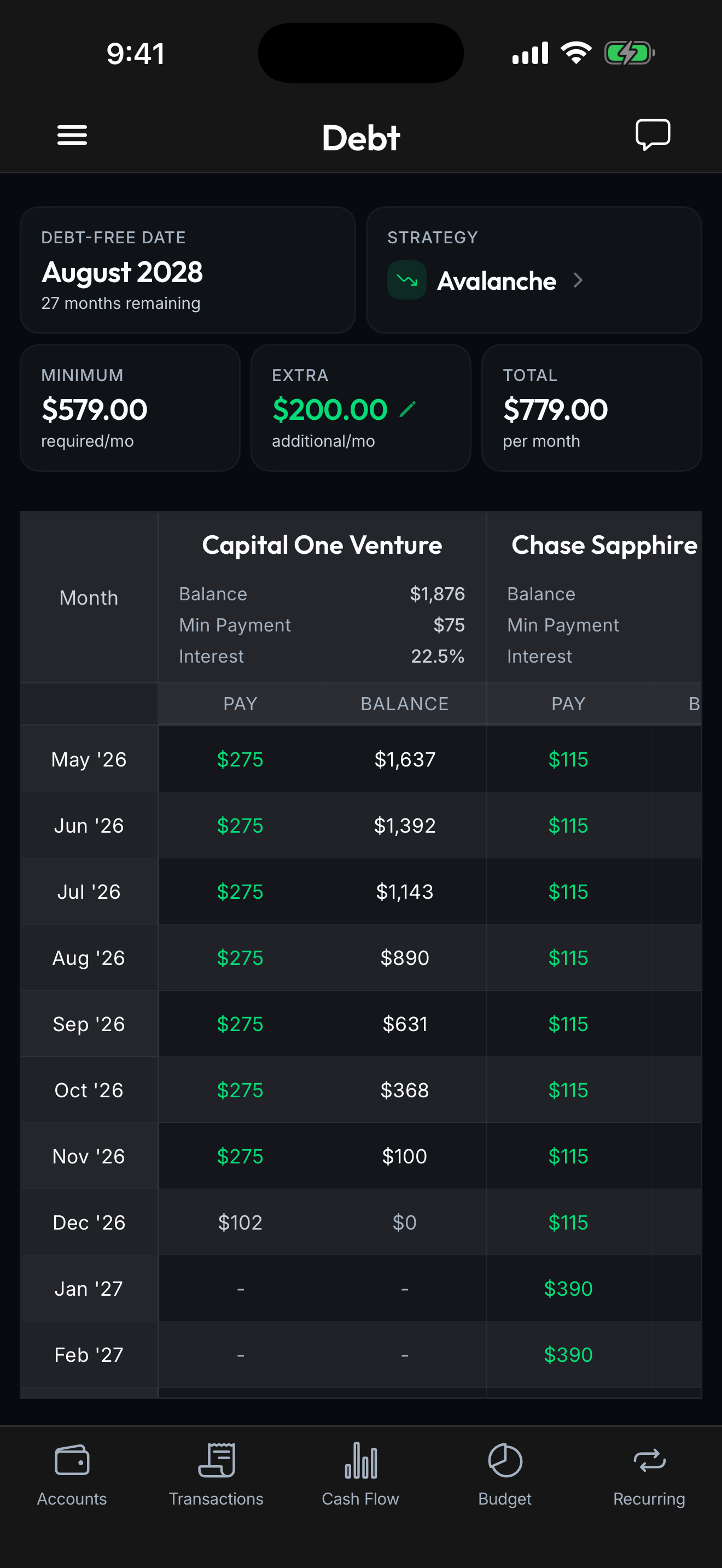
When rates are moving, debt payoff math has to update too. Spendify recalculates your debt-free date in real time as your balances, APRs, and payments change. Compare snowball vs avalanche on your actual numbers. Run a what-if for “what if APRs rise another half-point” or “what if I redirect $200/month to the highest-APR card.” Connect Plaid for read-only bank sync so the numbers stay current. $4.99/month or $49.99/year with a 7-day free trial via the App Store or Play Store. iOS + Android.
The volatile environment is the case for an actual plan, not against it.
See the debt payoff features → · Try the free debt payoff calculator →
Related reading: Why 111 million Americans can’t pay their credit cards · The true cost of minimum payments · Emergency fund: how much you actually need · Best Mint alternatives