Why 111 Million Americans Can't Pay Their Credit Cards (And the Plan That Works When You're One of Them)

Junior Y.
Founder, Spendify

The Federal Reserve Bank of New York’s Q1 2026 Household Debt and Credit Report dropped on May 12, and the topline numbers are now record-setting in three categories at once: U.S. household debt hit $18.8 trillion, credit-card balances hit $1.252 trillion, and about 111 million Americans, roughly 1 in 3 adults, are carrying a credit-card balance month-to-month. The five-year increase in the share of cardholders carrying a balance is 17%.
That’s not a story about people being irresponsible. It’s a story about how the minimum-payment math works against you when APRs are at multi-year highs and essentials keep getting more expensive. Here’s what’s actually happening, and what to do about it if you’re one of the 111 million.
Disclosure: We make Spendify. We’re going to mention how the app helps at the end. The first 90% of this post is straight math, and the bottom line is the same whether you use our app or a spreadsheet.
The minimum-payment trap, in real dollars
Pick a single $5,000 balance on a card at 24% APR with a 2% minimum payment. Pay only the minimum. How long does it take to clear?
22 years and 10 months. Total interest paid: $6,923.
That’s not a typo. You’d pay nearly $7,000 in interest on $5,000 of debt, and you’d be paying it for two decades. The 2% minimum payment exists precisely so the card issuer keeps you in the relationship: most of each early payment is interest, so the balance barely moves.
Now imagine you have three cards like that, which is closer to the average for someone carrying balances in 2026 (the NY Fed report shows the average cardholder has 3.9 open accounts). The interest stacks. The minimums stack. The runway feels endless because, mathematically, it nearly is.
Deeper read: The true cost of minimum payments →
Why this hit a record in 2026
A few things converged:
- APRs are at multi-year highs. The Fed’s rate-hike cycle pushed prime higher, and prime + margin is what defines card APRs. New offers in May 2026 are clustering at 22-29% APR for ordinary credit profiles.
- Inflation ate the slack. Groceries (+5.6% projected for 2026), insurance (auto and home up double-digits in many states), and rent in metro areas all ground into the buffer that used to absorb unexpected expenses. When the buffer is gone, the card fills the gap.
- One-time charges became recurring. The car repair that “just this once” goes on the card stays on the card because the minimum is the only payment that fits this month’s budget. Next month another one-time charge lands.
- The cure (lower rates) isn’t coming fast. April CPI came in at 3.8% YoY. Markets are now pricing in a higher chance the Fed hikes in 2026 than cuts. The “wait for refinancing to be cheap” plan that worked in 2020-21 is not the plan for 2026.
This is not a moral failure. It’s a math problem that’s gotten harder. The fix is also math.
The two payoff methods that actually work
Once you have multiple cards, you need a rule for where each extra dollar goes. Two methods are well-studied, and they’re the only two that consistently beat “pay a bit on each one” (which is the worst of both worlds, slow on every front).
Avalanche: highest APR first
Pay the minimum on every card; throw everything extra at the card with the highest APR until it’s gone; then roll the freed-up payment into the next-highest-APR card. Mathematically optimal. Saves the most interest.
Snowball: smallest balance first
Pay the minimum on every card; throw everything extra at the smallest balance until it’s gone; then roll the freed-up payment into the next-smallest. Higher psychological reward: you knock out a card sooner, which builds momentum. Behavioral studies show higher completion rates, even though it costs more interest.
The right answer depends on whether you’re more motivated by saved dollars or by quick wins. There is no third option that mathematically beats both. See debt snowball vs avalanche, with side-by-side math →.
The 4-card example, played out
Take a fairly typical 2026 situation:
| Card | Balance | APR | Minimum |
|---|---|---|---|
| Card 1 | $1,200 | 27% | $30 |
| Card 2 | $3,400 | 24% | $68 |
| Card 3 | $5,800 | 22% | $116 |
| Card 4 | $2,100 | 29% | $42 |
| Total | $12,500 | - | $256 |
You have $400/month available beyond minimums.
Minimums only: ~26 years to clear, total interest paid > $15,000.
Avalanche (Card 4 first → 2 → 1 → 3): about 38 months. Total interest ≈ $4,650.
Snowball (Card 1 first → 4 → 2 → 3): about 39 months. Total interest ≈ $4,940.
Avalanche saves $290 vs snowball. Meaningful, but not life-changing. The big win for both is vs the minimums-only path: you save more than $10,000 in interest and you’re done in 3 years instead of 26. The choice between the two strategies is about which one you’ll actually finish.
What about balance transfers and consolidation?
Balance transfer cards can shortcut the math if (and only if) you’ll genuinely pay off the balance during the 0% promo. A 21-month promo with a 4% transfer fee on $12,500 means you pay $500 upfront and avoid maybe $4,000 of interest, a clear win if you have the cash flow to clear the balance in 21 months. If you don’t, the promo ends, the rate snaps back to ~25%, and you’re in the same place. Most people who do balance transfers don’t fully pay off in time. More on this →
Personal consolidation loans can work when the loan APR is meaningfully lower than your card APRs and the term is short. A 3-year personal loan at 12% beats a 5-year loan at 18% which beats minimums on cards at 24%. Be wary of 7-year terms at marginally lower rates: total dollars paid often increases.
Debt management plans (through a nonprofit credit counselor) are a stronger option than they get credit for. They negotiate rate reductions on your behalf, typically into the 6-10% range, in exchange for a single monthly payment over 3-5 years. Worth a free consultation if your APRs are 22%+ and you can’t qualify for a personal loan at a reasonable rate.
The one thing missing from most advice
The advice usually stops at “pick a method and stick with it.” The thing that usually goes wrong is month four, when the initial energy fades and the balance still feels enormous because compound interest hides progress in the early months.
We wrote about month 4 specifically → because it’s the most common failure point and the math is counterintuitive: you’re actually further along than the balance suggests, but the dashboard doesn’t show it that way.
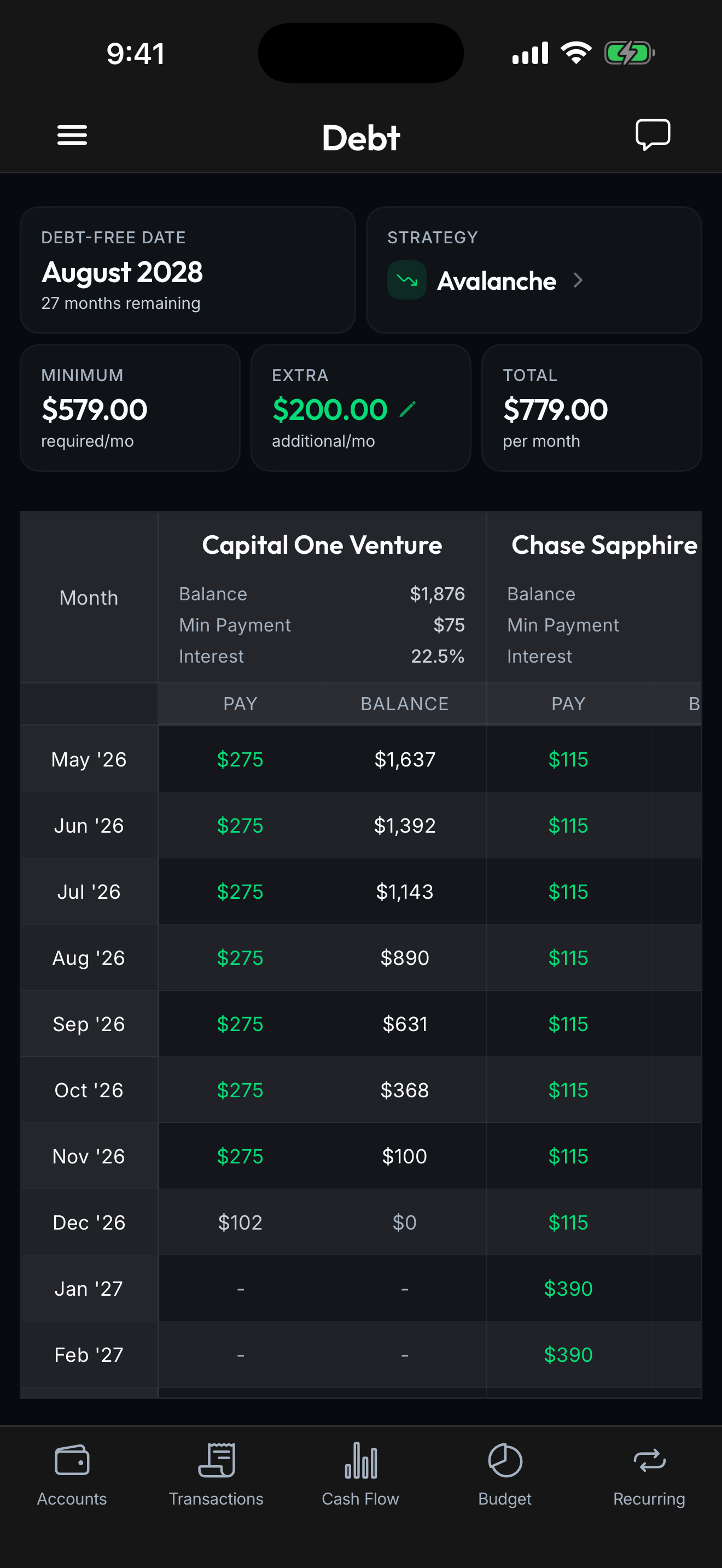
The fix that works for most people: a real, written debt-free date. Not “soon.” Not “this year.” An actual month: “August 2028, paying $400/month above minimums on the avalanche plan.” When the number gets emotional, the date is the anchor. Hit a windfall and put it toward debt, the date moves up. Miss a month, the date moves out. The date is the leading indicator that survives bad months.
Why your debt-free date matters more than the number →
Where Spendify fits
We made Spendify because most personal-finance apps tell you what you already know: your balance, your spending, the categories. They don’t tell you the one thing that matters when you’re in this situation: when does this end?
Spendify computes your exact debt-free date based on your real card balances, APRs, and payments. Snowball vs avalanche vs custom, side-by-side, in actual dollars saved. What-if scenarios update the date in real time: drop a windfall in, add an extra $50/month, switch strategies. Plaid handles the read-only bank sync. $4.99/month or $49.99/year with a 7-day free trial. Available on iOS, Android, and the web.
If you’re one of the 111 million, the plan that works is the one that ends. Get a date. Aim at it.
See the debt payoff features → · Mint shut down, what now? · How to create a debt payoff plan · 8 best debt payoff apps in 2026