The New Student Loan Repayment Plans in 2026 (RAP & Tiered Standard)

Junior Y.
Founder, Spendify

If you have federal student loans, July 1, 2026 is a date worth circling. A batch of changes from last year’s One Big Beautiful Bill Act takes effect: the Biden-era SAVE plan ends, two brand-new repayment plans open, and borrowing limits drop for grad students and parents. Roughly 43 million Americans hold about $1.7 trillion in federal student debt, and more than 7 million are still enrolled in SAVE, so this touches a lot of people.
Not every change hits every borrower. This guide walks through what’s actually new, who it affects, and how to pick a plan without overpaying.
If you’re on SAVE: your 90-day clock is about to start
SAVE, the most generous income-driven plan, which gave many low-income borrowers a $0 monthly payment, is officially ending after a long legal fight. If you’re one of the 7 million-plus still enrolled, your loan servicer will send a notice that starts a roughly 90-day window to choose a new plan.
Here’s the part that matters: if you do nothing, the Department of Education says it will move you into one of the least flexible plans, which usually means a bigger monthly payment than you had. Don’t let the default decide for you. Compare your options and switch deliberately before the clock runs out.
The two new plans
Repayment Assistance Plan (RAP)
RAP is the new income-driven option, and it’s the only new plan that scales with what you earn. Your payment is based on your adjusted gross income (AGI):
- Earn $30,001 to $40,000 → roughly $75 to $100/month
- Earn $50,001 to $60,000 → roughly $208 to $250/month
RAP has some genuinely borrower-friendly features. It waives any monthly interest that exceeds your payment (so your balance won’t balloon from unpaid interest), it includes a principal-matching payment that guarantees your principal drops a little every month, and it knocks $50 off your payment for each dependent in your household.
The trade-offs: forgiveness only kicks in after 30 years of repayment (by then there’s usually little left to forgive), and the plan isn’t indexed to inflation, so modest raises over time can push your payment up faster than you’d expect. You can enroll starting July 1.
Tiered Standard Plan
The Tiered Standard Plan is a fixed-payment plan, predictable, with no income calculation. What’s new is that the repayment term scales with your balance:
| You owe | You repay over |
|---|---|
| Under $25,000 | 10 years |
| $25,000 to $49,999 | 15 years |
| $50,000 to $99,999 | 20 years |
| $100,000 or more | 25 years |
A longer term for a bigger balance means smaller monthly payments, but also more interest and a longer relationship with the debt.
What legacy borrowers can still use
If all your loans were taken out before July 1, 2026 and you’re not borrowing more, you keep access to the familiar lineup: the Standard plan (10 years), Graduated, Extended (up to 25 years), and the income-driven plans IBR, ICR, and PAYE. Two caveats worth knowing: ICR and PAYE are being phased out by 2028, so enrolling in either buys you at most a couple of years before another switch. For most legacy borrowers who want a long-term income-driven plan, IBR is the durable choice.
The catch: the moment you take out any new loan after July 1, you’re limited to just RAP or the Tiered Standard Plan going forward.
New borrowing limits
For loans issued after July 1, 2026:
- Undergraduates: limits are unchanged (still $5,500 to $7,500 per year depending on year, up to $31,000 total for dependent students).
- Graduate students: newly capped at $20,500/year and $100,000 total, a big drop from the old “borrow up to the cost of your program.” Eleven categories of professional degrees (medicine, law, dentistry, pharmacy, veterinary medicine, and others) get a higher $50,000/year, $200,000 total cap.
- Parent PLUS: capped at $20,000/year per child and $65,000 total per dependent. New Parent PLUS borrowers can only use the Tiered Standard Plan: no income-driven options and no PSLF.
If you’re a current grad student mid-program, you may be grandfathered into the old limits if you were enrolled and had received a loan by June 30, 2026 and stay in the same program.
PSLF is still here
Public Service Loan Forgiveness survived. Work full-time (30+ hours/week) in qualifying public service, make 120 monthly payments on a qualifying plan, and your remaining balance is forgiven. IBR, ICR, PAYE, and the new RAP all qualify. One wrinkle: a new rule lets the department disqualify employers it judges to have a “substantial illegal purpose,” and several cities have sued over it, so if you’re chasing PSLF, follow that case.
How to choose without overpaying
The honest answer is that the “best” plan depends on your income, balance, family size, and whether you’re going for forgiveness. A few rules of thumb:
- Run the numbers before you pick. The Department of Education’s free Loan Simulator shows your payment and lifetime cost under each plan. Use it.
- If you have extra room in your budget, paying more than the minimum on a fixed plan can save serious interest, the same math that powers our free debt payoff calculator.
- If money is tight, an income-driven plan like RAP keeps payments manageable and protects you from runaway interest.
- Don’t miss the 90-day window. A deliberate switch almost always beats the default plan the department picks for you. Our companion guide, The SAVE Plan Is Gone: What to Do Before July 1, covers the step-by-step actions.
Where Spendify fits
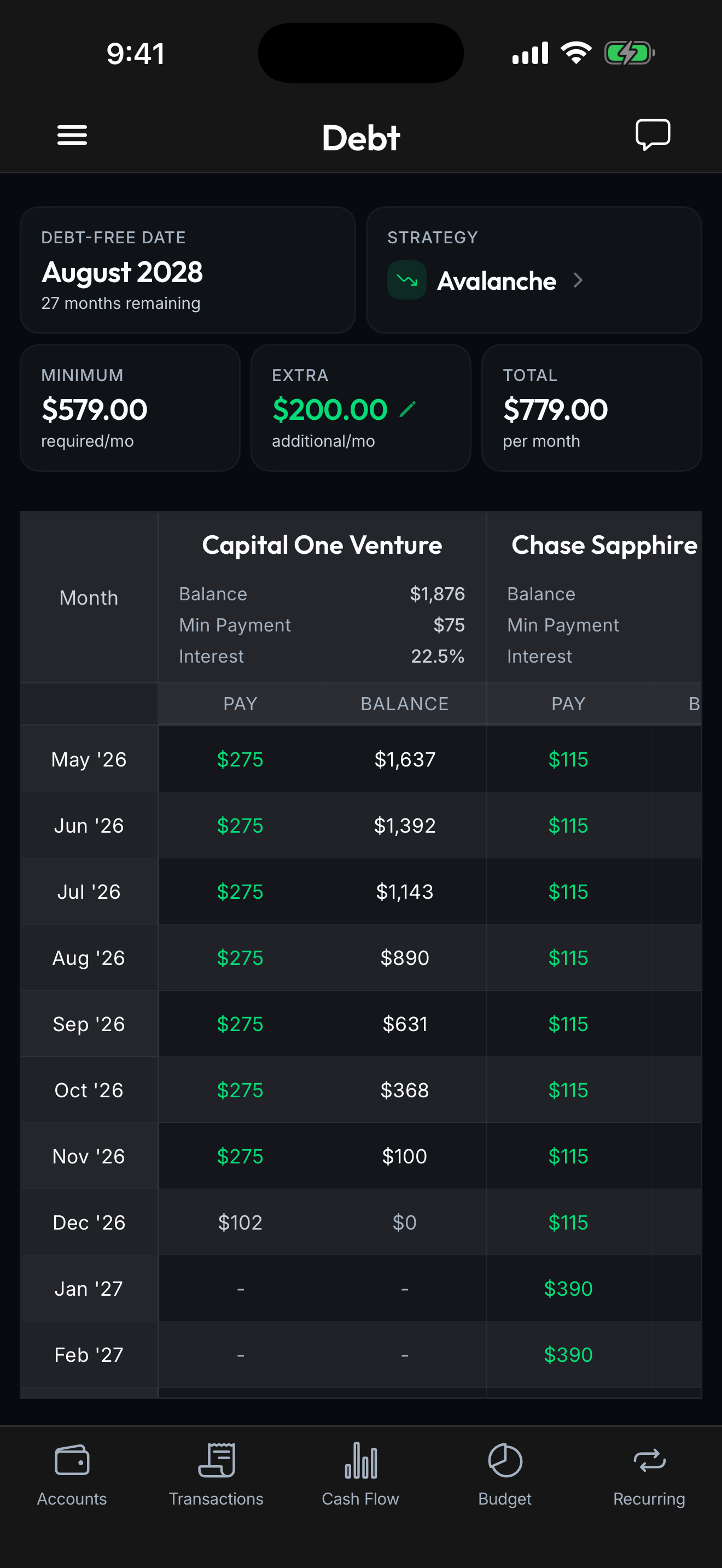
Your student loan payment doesn’t live in a vacuum. It competes with rent, groceries, credit cards, and savings. Spendify pulls all of it into one place so you can see whether a $250 RAP payment actually fits your month, model what an extra $100 toward principal does to your timeline, and track every balance as it falls. It won’t enroll you in a plan, but it will tell you, in real dollars, what each choice does to the rest of your finances.
$4.99/month or $49.99/year with a 7-day free trial. iOS + Android.
See the debt payoff features → · Free debt payoff calculator →
Related reading
- The SAVE Plan Is Gone: What to Do Before July 1: the action checklist for the deadline.
- Student Loan Payoff Calculator: The 2026 Guide: how to actually get out of debt, not just stay current.
- Best Apps to Pay Off Debt in 2026: tools to manage loans alongside the rest of your money.
- Built for student-loan borrowers →: how Spendify handles loans specifically.