ChatGPT vs Claude vs Gemini vs Copilot for Personal Finance (2026)

Junior Y.
Founder, Spendify

If you Google “ChatGPT vs Claude for personal finance” in 2026, you get a wall of identical articles. Every one tells you the same thing: ChatGPT is “versatile,” Claude is “thoughtful,” Gemini is “fast,” Copilot is “good in Excel.” None of them tell you which AI to actually use for a specific money problem you’re trying to solve.
We ran the same set of real personal-finance tasks through all four assistants and graded the outputs. Here’s what we found, and where the differences actually matter.
Disclosure: We make Spendify, a personal finance app. We’re going to mention how to connect any of these AIs to your real bank data in one section. The rest of this guide is straight comparison, including the parts where the AI does the job better than our app could.
The four contenders, at a glance
| Assistant | Maker | Latest model (May 2026) | Paid (per month) | Best at |
|---|---|---|---|---|
| ChatGPT | OpenAI | GPT-5.1 | $20 (Plus) | Everyday money Q&A, biggest plugin ecosystem |
| Claude | Anthropic | Opus 4.7 / Sonnet 4.6 | $20 (Pro) | Nuanced reasoning, long financial documents |
| Gemini | Gemini 3 Pro | $20 (Advanced) | Real-time data via Google search | |
| Copilot | Microsoft | GPT-5 in Copilot | $20 (Pro) | Excel, Word, and Microsoft 365 workflows |
All four are usable for personal finance. The decision is which one for which job.
Use case 1: Building a budget from scratch
Best: ChatGPT or Claude (tie)
We gave each model the same prompt: a household income of $7,200/month after tax, fixed expenses listed, two kids, in a high-cost-of-living city, and asked for a starting budget. ChatGPT and Claude both produced sensible 50/30/20-adjusted budgets with realistic line items. Claude was slightly better at flagging the “you didn’t include daycare” gap. ChatGPT was slightly better at suggesting specific dollar targets.
Where Gemini stumbled: it kept defaulting to generic budget templates and didn’t adjust for the high-cost-of-living signal. Where Copilot stumbled: it tried to push the conversation into Excel before answering.
Long-term, prompts are a clumsy way to build a budget. You have to retype your numbers every conversation. For an ongoing budget that updates as you spend, you want an app, not a chatbot. See our 50/30/20 explainer for the underlying framework.
Use case 2: Debt payoff math (snowball vs avalanche)
Best: Claude
This is the test where the gap is largest. We gave each model a four-card debt scenario (balances, APRs, minimums, and $400/month extra) and asked for snowball vs avalanche comparisons in total interest paid and time to debt-free.
- Claude got the math right on the first try and proactively pointed out that the snowball costs $1,140 more in interest but pays off the first card 6 months sooner, a behavioral note worth the trade.
- ChatGPT also got the math right but didn’t surface the behavioral angle until prompted.
- Gemini got the avalanche math right but botched the snowball ordering on round 2.
- Copilot built a clean Excel table but the formulas referenced the wrong cells and the totals were off.
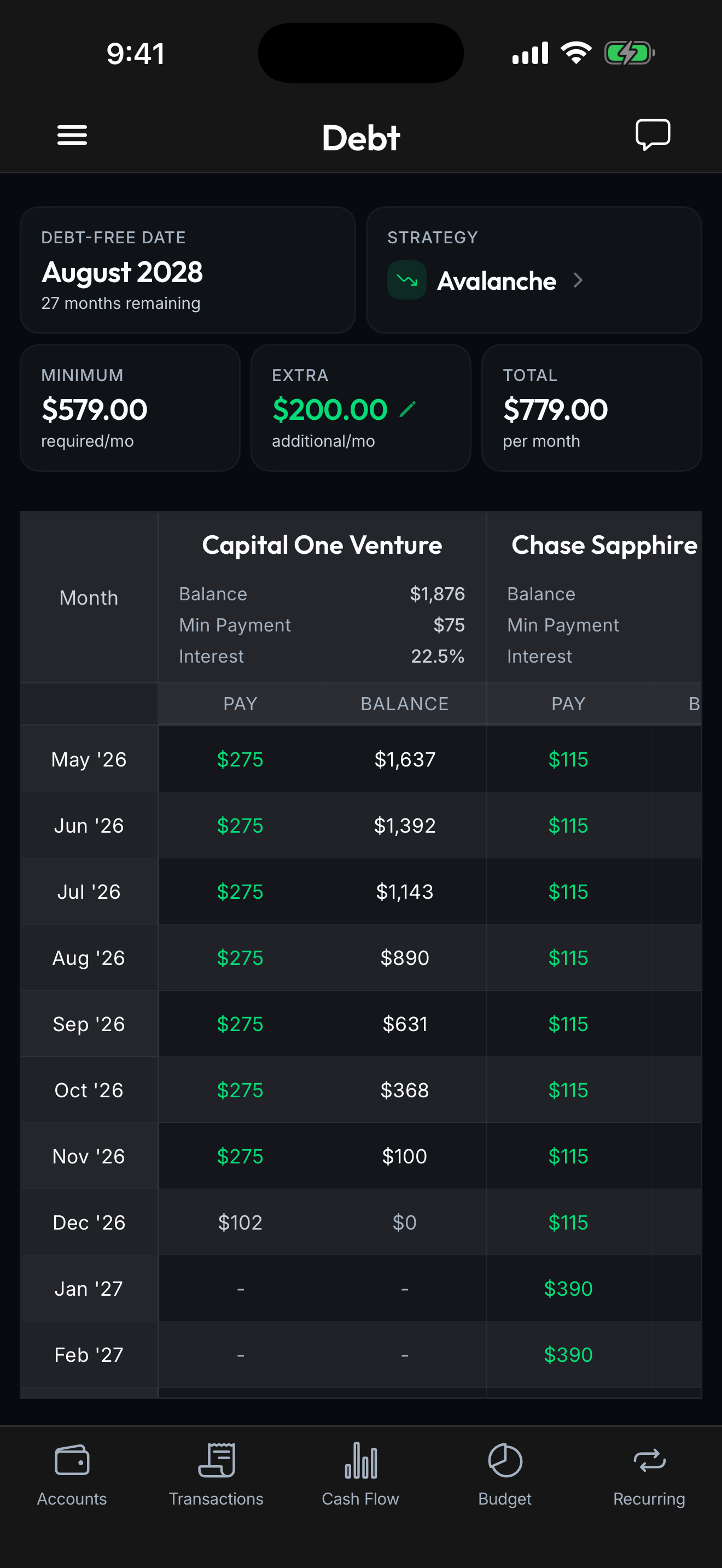
For the actual numbers and the side-by-side comparison in real dollars, an app does this better than any AI chat. See debt snowball vs avalanche, with side-by-side math or just run your numbers through our free debt payoff calculator.
Use case 3: “Should I file my own taxes with AI?”
Best: Claude (with a giant caveat)
TurboTax now has an integration on Claude (announced in April 2026) and ChatGPT has a similar partnership. For answering tax questions like what’s deductible, how does the standard deduction interact with the QBI, what counts as a hobby vs a business, Claude was the most cautious and the most accurate.
But “AI files my taxes” is still mostly marketing. None of these tools can submit a federal return for you without a human-built filing product behind them. The right way to use AI for taxes in 2026: gather documents, ask AI to explain anything confusing, redact PII, then file through TurboTax / FreeTaxUSA / a CPA.
We go deeper in Should you let AI file your taxes in 2026?.
Use case 4: Real-time market and rate questions
Best: Gemini
“What’s the 30-year fixed mortgage rate today?” “What’s the current HYSA leader?” “What did the Fed do at the last meeting?”
ChatGPT and Claude both browse the web on paid plans, but Gemini is materially better at pulling and citing live data because it sits on top of Google Search infrastructure. For anything time-sensitive like rates, prices, news, fund quotes, Gemini gives you the freshest answer and the most legible citation trail.
Don’t use Gemini for: long reasoning chains, debt math, or anything that benefits from holding a long context.
Use case 5: Reading a long financial document
Best: Claude
A 200-page 401(k) plan document. A 60-page mortgage closing package. A 12-page brokerage agreement with the small print on margin calls. Claude has the longest practical context window for these and is the most honest when it’s unsure. Drop the PDF in, ask “what’s the catch in this contract?” Claude gives the cleanest summary with the right caveats.
ChatGPT does the same job, slightly worse. Gemini hits length limits sooner on free tiers. Copilot is a mixed bag depending on whether the document is in OneDrive.
Use case 6: Daily money check-ins (“what did I spend this week?”)
Best: None of them, by default
This is the use case where every AI fails out of the box. None of them know your balances or your spending. You have three options:
- Paste a CSV every week. Works, but tedious and you have to repeat it.
- Use a finance app’s AI feature. Apps like Copilot Money have in-app AI, but you’re stuck with that app’s AI of choice.
- Use an MCP server to connect your finance app to any AI. This is the new standard in 2026.
Spendify ships the first first-party personal-finance MCP server. Once it’s wired up, Claude (or ChatGPT, Cursor, Gemini’s CLI tools) can ask Spendify questions in real time: “what did I spend on coffee in April?”, “am I on track to be debt-free by 2028?”, “build me a $400 grocery budget.” Your data never leaves the app. The AI just gets read-only access.
We have a full setup guide: how to connect Claude to your bank accounts.
The honest scoreboard
Here’s how the four models stack up on the dimensions that matter for personal finance, scored 1 to 5:
| Dimension | ChatGPT | Claude | Gemini | Copilot |
|---|---|---|---|---|
| Math accuracy on multi-step problems | 4 | 5 | 3 | 3 |
| Reasoning about trade-offs | 4 | 5 | 3 | 3 |
| Real-time data freshness | 4 | 3 | 5 | 4 |
| Plugin / integration ecosystem | 5 | 4 | 3 | 4 |
| Privacy posture (default training off) | 4 | 5 | 3 | 4 |
| Document understanding | 4 | 5 | 3 | 4 |
| Excel / spreadsheet integration | 3 | 3 | 3 | 5 |
| MCP server support | 3 | 5 | 2 | 2 |
Your tie-breaker is probably whichever one you already pay for.
Where AI assistants are still risky
Three places to be careful, no matter which model you pick:
- Specific numbers. Tax brackets, interest rates, fund expense ratios. Every model will occasionally hallucinate a confidently-wrong number. Verify before you act.
- “What should I invest in?” No model should be answering this with a specific buy/sell rec. They aren’t fiduciaries; they don’t know your full situation. Treat any specific ticker mention as a starting research point, not advice.
- Pasted account numbers / SSN. Don’t. Even with training disabled, a future breach or policy change could expose chat logs. Redact before pasting. Read our deeper take on AI financial data safety →
The bottom line
If you can only pick one assistant for personal finance in 2026: Claude for reasoning-heavy tasks (debt math, document review, tax scenarios), or ChatGPT for everyday breadth.
If you want any of them to actually know your numbers, what you spent this week, when you’ll be debt-free, whether you’re on track this month, bolt on a finance app’s MCP server. That’s the architecture that turns a smart chatbot into something that feels like a real money assistant.
See how Spendify’s MCP server connects Claude to your actual finances →
Related reading: Connect your finances to AI with MCP · AI financial advisor vs human · Questions to ask AI about your money