20 ChatGPT Prompts That Actually Help You Manage Money (2026)

Junior Y.
Founder, Spendify

The internet is full of “100 ChatGPT prompts for personal finance” listicles. Most of them are bloated, lifted from each other, and produce generic answers (“Help me create a monthly budget”). Useless.
This is the short version: 20 prompts we actually use, organized by what you’re trying to get done. Each one has been tested against ChatGPT, Claude, and Gemini. Where the AI is the wrong tool entirely, we say so.
Before you start: turn off training/chat history for these conversations. ChatGPT → Settings → Data Controls → “Improve the model for everyone” off. Claude is off by default. Gemini → My Activity → pause. And never paste full account numbers, routing numbers, or your SSN.
Prompt 0: The financial snapshot (paste this at the top of every other prompt)
Every prompt below works better when the AI already knows your numbers. Build this once, save it in a note, paste it at the top of any money conversation:
Financial snapshot:
- Monthly take-home: $___
- Fixed costs (rent, utilities, insurance): $___
- Variable spending average: $___
- Debt balances and APRs:
  • Card 1: $___ at __%
  • Card 2: $___ at __%
  • Loan 1: $___ at __%
- Emergency fund balance: $___
- Retirement balance: $___
- Goals: [pay off debt by X, save Y, etc.]
Round to the nearest $100. Don’t include account numbers. That’s it.
Section 1: Building and fixing a budget (5 prompts)
1. Find the leak
Here's my spending for the last 30 days, by category: [paste category totals].
My take-home is $___/month. I feel like I'm overspending but I can't tell where.
Identify the top 3 categories that are out of line with a typical budget for my income,
and tell me realistic targets I could hit without major lifestyle changes.
Best with Claude. ChatGPT also strong. Gemini tends to default to generic 50/30/20 advice.
2. Build a zero-based budget
Take-home is $___/month. Help me build a zero-based budget where every dollar has a job.
Include: rent/mortgage [$___], utilities, groceries, transportation, debt payments [list above],
savings (emergency + retirement), and discretionary. Show as a table with target $ and % of income.
End with one sentence on whether this budget is realistic for my city: [city].
3. The 50/30/20 audit
Given my income ($___) and expenses [paste], grade me on the 50/30/20 rule.
What % am I actually spending on needs, wants, and savings? Where do I deviate,
and is it a problem or just my situation?
Deeper read: 50/30/20 explained →
4. The “I blew the budget” recovery plan
I overspent by $___ this month. Help me build a 30-day catch-up plan that doesn't
require giving up everything. What are the 3 highest-leverage cuts I can make next month,
and what's a realistic timeline to get back on track without quitting on the budget entirely?
Related: what to do when you’ve blown your budget →
5. The kid-budget add-on
We have [#] kids ages [list]. Daycare costs $___, plus typical kid expenses.
Adjust my budget [paste] to be realistic for a family. Where do most families
underestimate spending, and what category am I likely missing?
Section 2: Debt payoff (4 prompts)
6. Snowball vs avalanche comparison
Debts:
- Card 1: $___ @ __% APR, $___ minimum
- Card 2: $___ @ __% APR, $___ minimum
- Loan: $___ @ __% APR, $___ minimum
Extra payment available: $___/month.
Calculate total interest paid and months to debt-free for both snowball
(smallest balance first) and avalanche (highest APR first). Show as a table.
This is the prompt where Claude consistently wins. ChatGPT is fine. Gemini will sometimes mis-order.
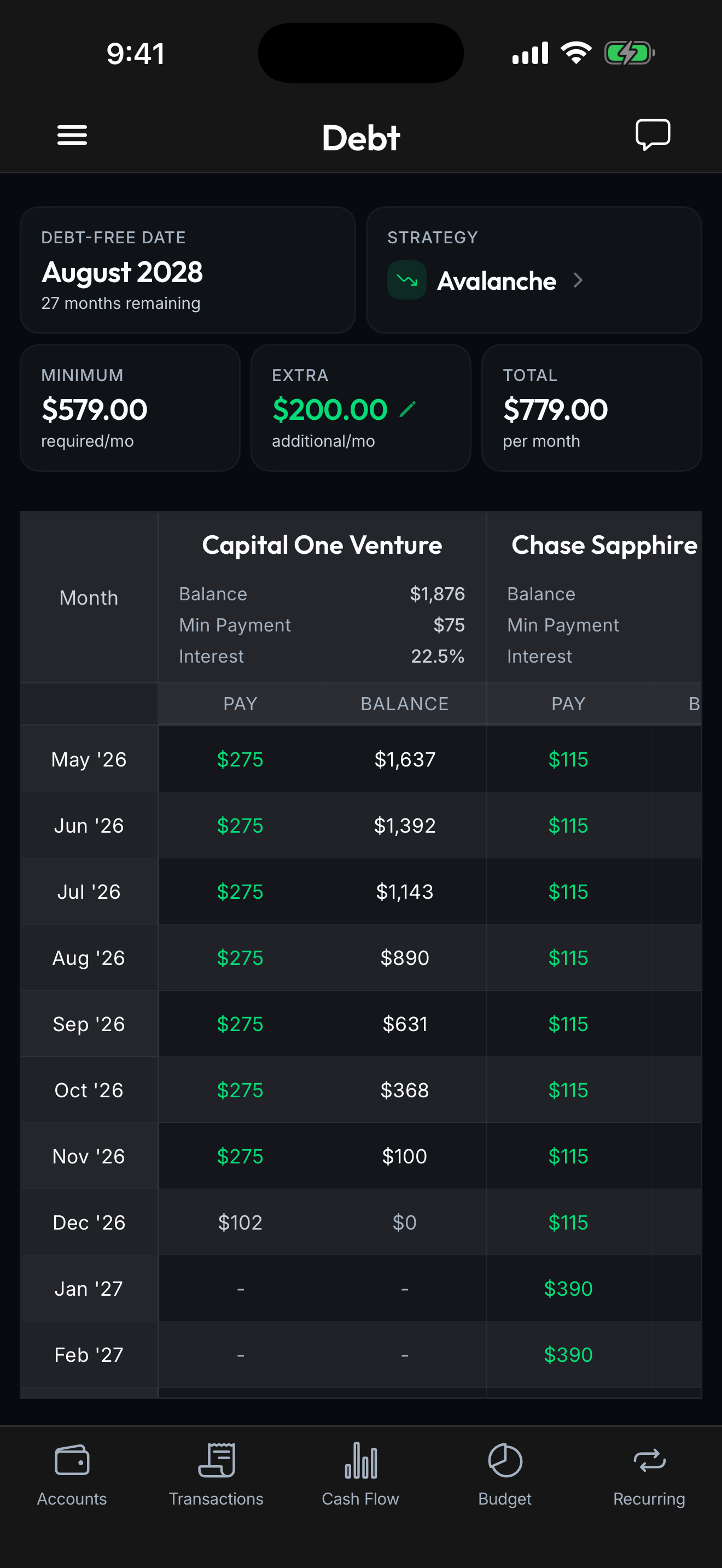
Honest caveat: prompts are a clumsy way to do this once. An app does it permanently. Run your numbers through our free debt payoff calculator → or see snowball vs avalanche with the math.
7. The “what if I throw $X extra” simulator
[Paste financial snapshot]. If I redirected $___/month from [category] to my
highest-APR debt, how many months earlier would I be debt-free, and how much
interest would I save total?
8. Balance transfer evaluation
I have a balance transfer offer: __% APR for __ months, __% transfer fee.
My current card is $___ at __%. I can pay $___/month. Should I take the offer?
Show the math: total cost of staying put vs. transferring.
Related: the truth about balance transfer cards →
9. Minimum payment reality check
I have $___ in credit card debt at __% APR. If I only pay the minimum (let's
assume 2% of balance), how long until it's paid off and how much will I pay
in total? Show the math.
The answer is always shocking. Deeper read: the true cost of minimum payments →
Section 3: Subscription and recurring expense audits (3 prompts)
10. Subscription gut-check
Here are my recurring monthly subscriptions: [list, $ each].
Rank them by likely value-per-dollar based on how often the average person actually
uses each service. Flag any that overlap (e.g., two streaming services with similar
catalogs). Be opinionated.
11. The annualizer
Calculate the annual cost of these monthly subscriptions [list]. Show the total
and compare it to a likely return if invested at 7% over 10 years. Make it visceral.
Related: the subscription trap →
12. The “I’m canceling everything” plan
Here are my subscriptions [list]. Give me a script to cancel each one: what to say,
what to expect (retention offers), and which ones often have a hidden cancellation flow.
Section 4: Money decisions (4 prompts)
13. Job offer evaluator
Current comp: $___ base + $___ bonus + [benefits].
New offer: $___ base + $___ equity + [benefits]. New city COL is __% [higher/lower].
Compute the effective comp difference after tax and COL adjustments. What am I
likely missing in this comparison?
14. Rent vs buy
Median home price in [city]: $___. Mortgage rate today: __%.
Down payment available: $___. Current rent: $___/month.
Compute the 5-year cost of buying vs. renting, including maintenance (1% of home value),
property tax, and opportunity cost of the down payment. Where is your math sensitive
to assumptions I should question?
15. Big purchase decision
I'm thinking about spending $___ on [thing]. My take-home is $___ and I have
$___ in debt at __% APR. Walk me through whether this is a "use cash, no big deal"
purchase, a "use credit, pay off in 90 days" purchase, or a "wait" purchase. Be direct.
16. The vacation budget
We're planning a [#]-day trip to [destination] for [#] people in [month].
Realistic total budget including flights, lodging, food, activities, and a 15% buffer.
Suggest 3 versions: bare-bones, comfortable, splurge.
Section 5: Money conversations (2 prompts)
17. The money-talk script
My partner and I haven't done a money check-in in months. We disagree on
[savings rate / spending priorities / specific purchase]. Write me a calm opening
script for a 30-minute money conversation, with 3 questions I should ask
and 3 things I should not say.
Related: couples and the money talk →
18. The salary negotiation script
I'm negotiating a $___ → $___ raise. The company line is "budgets are tight."
Write 3 different anchoring scripts (data-driven, value-driven, walk-away-leverage)
I can use in a Tuesday meeting. Each under 60 seconds spoken.
Section 6: Investment and savings basics (2 prompts)
19. Asset-allocation gut-check
I'm [age], have $___ in retirement, contributing $___/month. My current allocation
is [list]. Is this in the right ballpark for my age, or do I have an obvious
imbalance? Be specific. Don't recommend specific funds, just call out the structural issue.
20. The HYSA / CD / bond comparison
I have $___ I want to keep liquid-ish for the next [#] months. What are the trade-offs
between a high-yield savings account, a CD, and short-term Treasuries today? Give me
the math, not the marketing copy.
When prompts are the wrong tool
If you’re using these prompts more than once a month, you’re hitting the limit of what chat-based AI can do for personal finance. The friction is real: you have to retype your snapshot every conversation; the AI doesn’t remember what you decided last time; it can’t update its answer when your numbers change.
The fix in 2026 is to bolt your finance app onto your AI. Spendify’s MCP server lets Claude (or ChatGPT, Cursor, etc.) query your real spending, balances, and debt-payoff plan on demand, with no copy-paste and no stale numbers. Same prompts, real data.
See the setup guide → · How to use AI to manage your money → · 5 questions to ask AI about your money →