Good Debt vs Bad Debt: A 2026 Framework for $18.8T in Debt

Junior Y.
Founder, Spendify

The Federal Reserve Bank of New York’s Q1 2026 Household Debt and Credit Report put U.S. household debt at a record $18.8 trillion. That number got the headlines, but the analysts reading it had a more useful take: as one Bankrate analysis put it, most of that debt is “good,” and the warning is about the “bad” slice hiding inside the total.
That’s the right frame, and it’s the one this post is built on. A record debt number tells you almost nothing about whether your finances are healthy. What matters is the kind of debt you carry, and most people have never sat down and sorted theirs. This is a classification framework: which of your debts are working for you, which are working against you, and what order to deal with them in.
This isn’t a payoff-method explainer. For the how (snowball vs avalanche, the real math), we already wrote the playbook for getting out from under high-interest debt. This post is the step before that: figuring out what to prioritize.
Why the $18.8 trillion headline is misleading
A record total debt number sounds alarming, but it conflates two completely different things. The large majority of that $18.8 trillion is mortgage debt, borrowing against an asset that typically appreciates, at rates far below credit cards. That’s not a crisis; for most households it’s the largest “good debt” they’ll ever hold.
The dangerous part is a much smaller slice: high-interest revolving debt. It’s smaller in dollars but outsized in damage, because it compounds against you at rates that can exceed 20%. A record total can coexist with millions of perfectly stable households and millions of strained ones at the same time. The total can’t tell you which you are. Your mix can.
The test: good debt vs bad debt
Here’s the dividing line, in one table:
| Good debt | Bad debt | |
|---|---|---|
| Interest rate | Low | High (often 20%+) |
| What it bought | An asset that appreciates or earns | Consumption that depreciates |
| Tax treatment | Often advantaged (e.g. mortgage interest) | None |
| How it behaves | Builds value over time | Compounds against you |
| Examples | Mortgage, federal student loans, some business loans | Credit cards, buy-now-pay-later, payday loans, high-rate personal loans |
The quick gut check: is the rate low and the thing it bought likely to grow or earn? Then it’s closer to good debt, not an emergency. High rate, and it bought something that’s already losing value? That’s the debt doing damage, and it goes to the front of the line.
A caveat worth naming: “good” doesn’t mean “free.” Even low-rate debt is an obligation, and too much of any debt relative to your income is a risk. The framework sorts priority, not permission.
Good debt: manage it, don’t panic over it
Mortgages, federal student loans, and certain business loans usually land on the good side. They’re low-rate, often tax-advantaged, and tied to something like a home, your earning power, or a business that builds value or income over time.
The mistake here is over-paying them out of anxiety. Throwing every spare dollar at a 5% mortgage feels responsible, but that money often does more good in an emergency fund, a retirement account, or against a 24% credit card. Federal student loans are their own evolving picture in 2026. If that’s you, see the new repayment plans. But the principle holds: low-rate, asset-backed debt is something to manage steadily, not to attack in a panic.
Bad debt: this is the line
Credit cards, buy-now-pay-later, payday loans, and high-rate personal loans are the debt that quietly wrecks a budget. The rates are high, the purchases don’t appreciate, and the minimum-payment structure is designed to keep you paying interest for years.
Buy-now-pay-later deserves a specific flag in 2026. It’s marketed as frictionless and often interest-free up front, which makes it feel harmless, but it fragments your spending into obligations that are easy to lose track of, and missed payments can carry steep penalties. When BNPL is being used to cover essentials rather than the occasional splurge, that’s one of the clearest signs you’ve drifted to the strained side of the economy, no matter how normal it feels.
This is the debt to attack first, hardest, and on a written plan.
The priority order
Put it together and the sequence almost writes itself:
- Small starter emergency fund first: enough to keep a surprise from going straight onto a card.
- Attack bad debt: highest-rate balances first, on a real plan. This is where your aggressive dollars go.
- Build a full emergency fund: once the high-interest bleeding has stopped.
- Invest for the long term: retirement and 5+ year goals.
- Optionally, pay extra on good debt: only after the above, and only if you prefer the peace of mind over the alternative uses.
Notice that good debt is last, and that’s deliberate. The money you might pour into a low-rate mortgage almost always does more for you earlier in this list.
Which side are you on?
Forget the $18.8 trillion. The only number that tells you something about your finances is whether your high-interest balances are zero or shrinking. If your debt is mostly low-rate and asset-backed, and your cards are paid or falling each month, you’re on the stable side. Manage steadily and keep going. If you’re carrying revolving balances above 20% that aren’t moving, or leaning on BNPL for essentials, that’s the signal, and the fix is the same as it’s always been: a written plan with an actual end date, not a vague intention.
A record debt headline is a story about the country. Your debt mix is the story about you, and it’s the only one you can do anything about.
Where Spendify fits
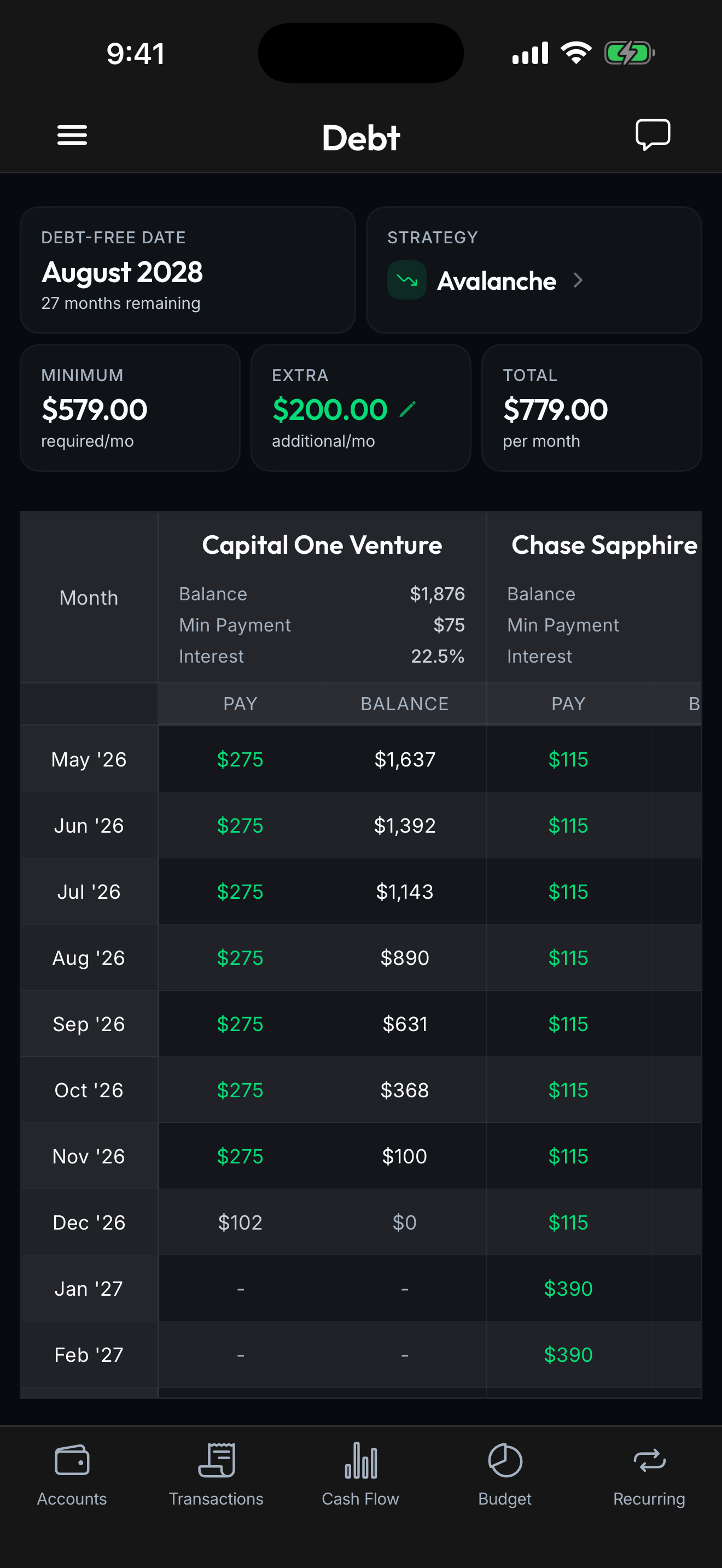
The reason most people have never sorted their debt into good and bad is that they’ve never seen it all in one place. It’s spread across a mortgage servicer, a couple of cards, a student loan portal, and a BNPL app. Spendify pulls every balance into one view, sorts the high-interest debt that needs attention from the low-rate debt that doesn’t, and computes your exact debt-free date for the balances you’re attacking. You can see, in real dollars, what paying off the bad debt first does to your timeline, and stop worrying about the good debt that was never the problem.
$4.99/month or $49.99/year with a 7-day free trial. iOS + Android.
See the debt payoff features → · Free debt payoff calculator →
Related reading
- Why 111 Million Americans Can’t Pay Their Credit Cards: the payoff-method playbook for the bad debt.
- The True Cost of Minimum Payments: why high-interest debt is so hard to escape.
- Credit Score vs Debt Freedom: which to optimize for, and when.
- Should You Invest While in Debt?: where investing fits in the priority order.