Tariffs Are Adding $570 to Your Grocery Bill This Year: 9 Real Ways to Fight Back

Junior Y.
Founder, Spendify
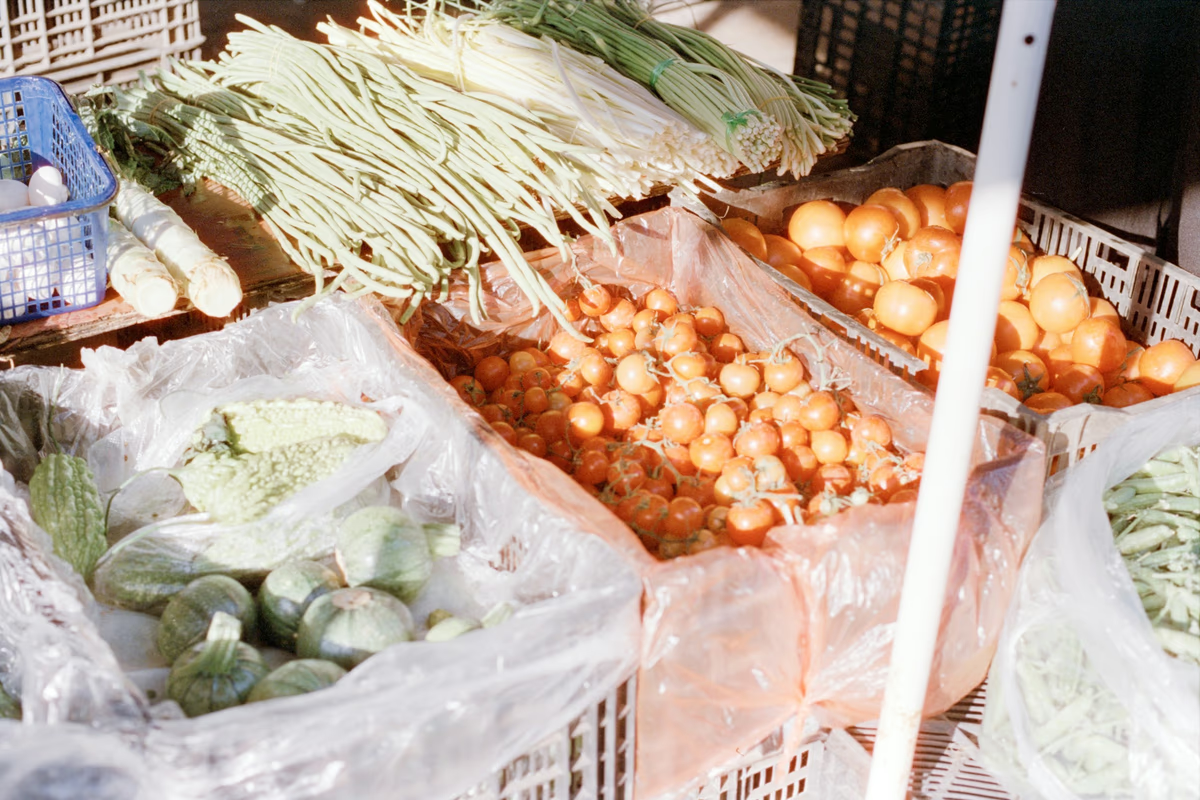
The Yale Budget Lab pegs the 2026 tariff cost at about $570 per U.S. household. The CBS News price tracker has food up roughly 20% since January 2022. Morningstar projects another 5.6% rise in food and household staples this year. AARP’s running list of “12 things getting more expensive in 2026” is dominated by grocery items.
Translation: the grocery line in your budget is doing more damage in 2026 than it did in 2025, and “shop the sales” isn’t a real strategy. Here are nine changes that actually move the number, ranked by how much per-month savings they typically produce, not by how clever they sound.
Disclosure: We make Spendify, a personal finance app. We’re going to mention the categorization angle at the end because that’s where Spendify earns its keep. The first 90% of this guide works regardless of what app you use.
1. Change where you shop, not what you buy. ($50-150/month)
Bigger lever than any single product swap. Switching a typical $800/month full-service grocery bill to Aldi (where Aldi has your neighborhood) usually drops it to $580-650. Costco can match Aldi if your household consumes the volume. Warehouse clubs and limited-assortment chains have pricing power that traditional grocery chains don’t.
The trap: dual-shopping at Costco and full-service for “the things Costco doesn’t carry.” If you can’t replace the full-service trip, the Costco trip is additive.
What to do: pick one anchor store. Use the others only for genuinely missing items.
2. Build the meal plan first, then the list. ($40-100/month)
Most overspending happens at the store, not at home. People walk in without a plan, the store is designed to suggest items, and 15-25% of the cart is unplanned by checkout.
Counter: write out the week’s meals on Sunday, then build the grocery list from the meals. Buy what’s on the list. Skip the rest. The shift sounds trivial. It’s the single biggest swing in studies of grocery overspending behavior.
For families: assign two “lazy nights” per week (frozen pizza, breakfast for dinner, leftovers) so you don’t try to plan 7 elaborate meals and abandon the plan by Wednesday.
3. Default to store brands. ($30-80/month)
Store brand on staples, like pasta, canned tomatoes, frozen vegetables, dairy, eggs, basic cereal, flour, sugar, spices, is typically 20-30% cheaper than the name brand. Often made in the same factories. Sometimes literally the same product.
Carve out exceptions only for the small number of items where you can taste/feel a real difference. For most pantry staples, you can’t.
4. Stop buying “fresh” things you don’t eat. ($30-100/month)
The most common grocery leak we see in Spendify users isn’t the expensive item. It’s the aspirational item. The cilantro that browns in the crisper. The bag of spinach that goes slimy on day five. The fancy yogurt that gets pushed to the back. Track which items you throw away two weeks in a row and stop buying them.
Frozen vegetables are 30-50% cheaper than fresh, last 6-9 months, and are nutritionally equivalent for most uses. Frozen wins for things you’ll cook (stir fry, soups, sauces). Fresh wins for things you’ll eat raw (salads, fruit you’ll snack on within 3 days).
5. Eat down the freezer / pantry once a month. ($25-75/month)
Pick one week a month where the rule is: cook only from what’s already in the house. You’ll burn through forgotten frozen meat, half-used dry goods, and the random can of beans that has been there since 2024. The grocery bill for that week drops to almost zero, and you stop the slow-creep accumulation of partial ingredients.
This works best when the week is on the calendar (not “we’ll do it sometime”) and when you actually inventory the freezer first.
6. Cut one restaurant meal per week. ($60-200/month)
Not “stop eating out.” Just one fewer meal per week. A $40 dinner-for-two restaurant meal vs an $8 home-cooked equivalent saves about $130/month, without lifestyle damage. People who try to cut all restaurants usually cave by week three. People who cut one per week usually keep the habit.
Related: the psychology of spending →
7. Audit the daily coffee. ($90-180/month)
A $6 daily latte is $180/month. A $1 coffee at home is $30/month. A $10/lb bag of decent beans is about $0.50/cup. The math is brutal.
If you don’t want to give it up entirely: keep it 2-3 days a week and make it the rest. The lever is the cadence, not the existence of the habit.
8. Use the credit card cash-back category you already have. ($15-40/month)
Most cash-back cards (Amex Blue Cash, Citi Custom Cash, Bank of America Customized Cash, etc.) have a 3-6% category. Use the card that pays the highest cash-back on groceries for every grocery purchase. On a $700/month grocery bill, that’s $20-40/month back, assuming you pay the balance in full every month. (If you carry a balance, the rewards are wiped out by interest. See the credit-card debt math →.)
9. Stop the “I’m just here for one thing” trip. ($30-80/month)
The single-item grocery trip is the most expensive trip per item, every time. You’re never just there for the one thing. You grab two or three other things, and those extras average $15-25 per trip. Cut these by keeping a running list and consolidating into one weekly trip.
Order-online-pickup is a quiet ally here: you cannot impulse-buy what you didn’t put in the cart from your couch.
What this looks like over a year
If you implement four of these, change anchor store, plan meals, default to store brand, and cut one restaurant per week, you’d typically see $200-400/month in saved spending. Across the year, that’s $2,400-4,800. More than the entire tariff cost, with margin to spare.
If you implement most of them, the number stacks. The realistic ceiling for a household genuinely trying is about $500/month in grocery-and-food-out savings, equivalent to a 30-40% reduction.
Where Spendify fits
The reason “where does my food money actually go” is hard to answer for most people is that everything food-adjacent gets lumped together. Spendify auto-splits food spending into groceries, restaurants, coffee, and convenience, so you see which one is the actual leak instead of guessing. When the tariff news pushes prices up, the category you cut matters as much as the dollar amount, because cutting the wrong one means more pain for less savings.
Spendify uses Plaid for read-only bank sync, computes your spending by category in real time, and shows month-over-month changes so you catch leaks as they happen rather than at the end of the year. $4.99/month or $49.99/year with a 7-day free trial. iOS + Android.
See the budgeting features → · 50/30/20 explained · The subscription trap · Small expenses, big impact · Lifestyle creep