Should You Let an AI Agent Spend Your Money? (2026)

Junior Y.
Founder, Spendify

In 2026, the question stopped being theoretical. Robinhood launched an agentic credit card and agentic trading, letting an AI make purchases and trade equities on customers’ behalf, and American Banker called it a “wake-up call” for banks. A few days later, a startup gave AI agents the keys to a real bank account. The pitch is seductive: an assistant that doesn’t just tell you what to do with your money, but does it.
Quick answer: Letting AI read your money is low-risk and genuinely useful. Letting AI spend your money is a different category: powerful, but only as safe as the limits you put around it. In 2026, the tooling is early and the guardrails are thin. For most people, the right move is to use AI for analysis and planning now, and leave autonomous spending alone until it’s proven.
Disclosure: We make Spendify, a personal finance app. We deliberately don’t let AI move your money. Spendify reads your accounts and plans your payoff, and that’s by design. So we have a point of view here. We’ll still lay out the honest case on both sides.
Reading your money vs. acting on it
The single most useful distinction in this whole conversation: there’s a world of difference between AI that reads your finances and AI that acts on them.
Reading is what ChatGPT’s new bank connection does, what a finance app’s analysis does, what an MCP server does. The AI sees your balances and transactions and answers questions. The worst-case failure is a wrong answer, annoying, but it didn’t cost you anything.
Acting is what an agentic card or agentic trading does. The AI moves real money. Now the worst-case failure is a wrong transaction: a purchase you didn’t want, a trade at the wrong moment, a recurring charge an agent set up and forgot. The downside has teeth.
That asymmetry is the whole story. Reading is almost all upside. Acting is a real tradeoff you have to manage.
The case for agentic finance
It’s not all risk. There are genuine reasons people are excited:
- Friction kills good intentions. The reason people miss savings goals isn’t usually knowledge. It’s follow-through. An agent that automatically sweeps $50 to savings the day after payday removes the step where willpower fails.
- Speed. Some financial decisions are time-sensitive. An agent that acts on a rule you defined can move faster than you checking your phone.
- Consistency. Agents don’t get tired, distracted, or emotional. A rule executed the same way every time can beat a human who sometimes forgets.
For narrow, well-bounded tasks, like “round up every purchase and invest the change,” “pay this exact bill on this exact date,” automation has been quietly useful for years. Agentic AI is the more ambitious version of that idea.
The case against (or at least, “not yet”)
Here’s where the honesty matters.
The guardrails are immature. When Yahoo Finance covered Robinhood’s agentic card, the headline was a question, “Should you trust AI to make purchases?”, and the article was mostly about what to check before opting in. That’s telling. In early 2026, the limits, confirmations, and audit trails around agentic spending are still being figured out.
Mistakes compound differently. A misread balance is a bad answer. A bad trade or an erroneous purchase is a financial event you may not be able to undo. The blast radius is larger.
Account compromise gets worse. If someone gets into a read-only AI connection, they learn things about you. If they get into an agent with spending authority, they can move money. Giving an AI the ability to act raises the stakes of every security failure downstream of it.
It can mask the real problem. Automating your money can paper over the fact that you don’t actually have a plan. An agent that optimizes your spending is no substitute for knowing where your money goes and when you’ll be out of debt.
If you try it: the limits are the point
Not “set limits as a precaution.” The limits are the product. If you experiment with an agentic tool, treat the guardrails as the whole reason it’s safe to use:
- Cap the amount. A hard ceiling per transaction and per day.
- Restrict scope. Specific merchants or categories, never “anything.”
- Require confirmation above a threshold. Small, routine actions can be automatic; anything meaningful should ask you first.
- Use a sandboxed account. Point agents at a small, separate balance, never your primary checking or your emergency fund.
- Read the log. Check the transaction history often. An agent you never audit is an agent you don’t actually control.
This is the same instinct behind our broader take on whether it’s safe to give AI your financial data: the technology can be fine; the defaults are what get you.
Where Spendify fits
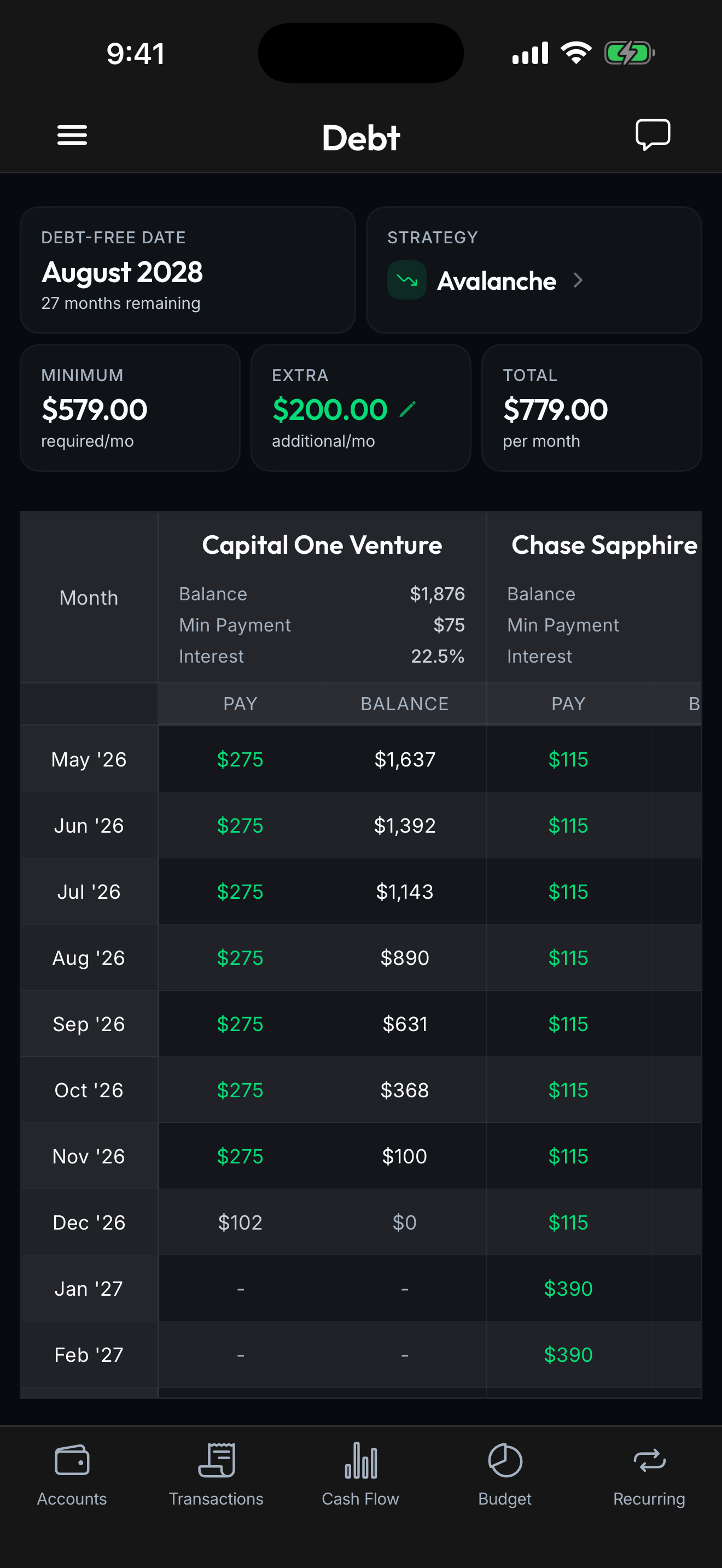
We made a deliberate choice: Spendify reads your accounts and plans your money, but it doesn’t spend it. We connect through Plaid (read-only), calculate your exact debt-free date, compare payoff strategies in real dollars, and, through our MCP server, let Claude or ChatGPT reason over that plan. We think the highest-leverage thing AI can do with your money in 2026 isn’t to spend it autonomously; it’s to help you understand it and make a better decision yourself. That’s a smaller promise, and a more honest one.
$4.99/month or $49.99/year. iOS, Android, and web.
See how Spendify plans your money (without moving it) → · Connect AI to your finances with MCP →
Related reading: Is it safe to give AI your financial data? · ChatGPT can now connect to your bank accounts · AI financial advisors vs. human advisors